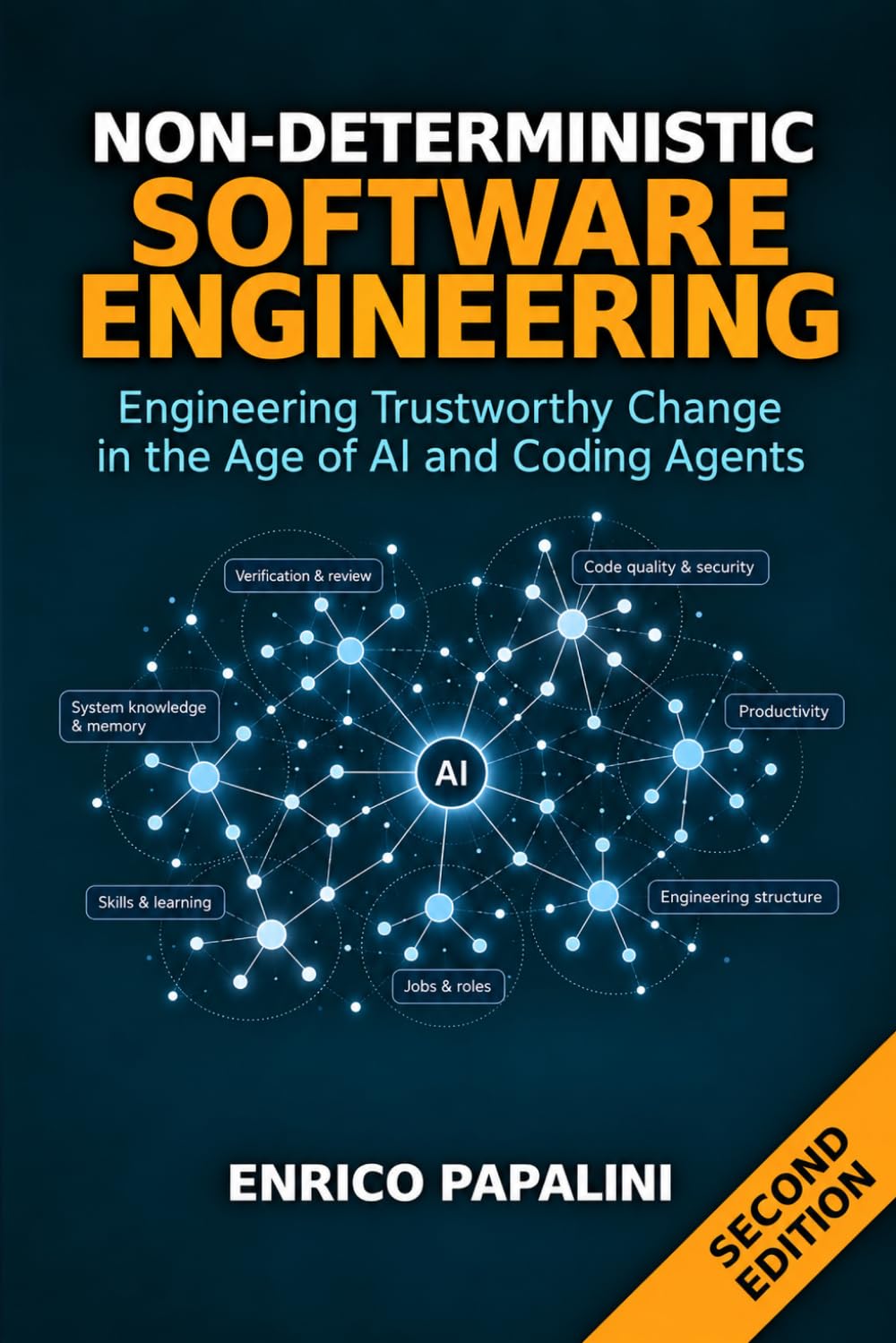
13 chapters from the published Non-Deterministic Software Engineering, Second Edition. English and Italian titles, section outlines and literal source citations are reconciled to the author-supplied final 13.7.1 sources.
No matching records. Clear the search or choose another group.
NDSE2:C01NDSE2 chapters
Enrico Papalini · 2026
L'AI cambia l'unità di lavoro della software engineering
Defines an accepted, operable change as the unit of engineering work. The approval-routing case separates business intention, implementation, verification and acceptance, showing why brownfield understanding and explicit decision rights still matter when an AI agent generates the patch.
Chapter guide and cited sources →
Evidence, context & provenance
Evidence boundaryAuthor engineering synthesis and teaching material; publication is not independent empirical validation.
Source type, as recorded: Published author chapter; engineering synthesis
Learning goals
- distinguish an implementation artifact from an accepted change
- name the people and evidence required between a request and release
- scope an AI assistant's task without delegating business authority
Obiettivi in italiano
Obiettivi di apprendimento
- distinguere un artefatto di implementazione da una modifica accettata
- identificare le persone e le evidenze necessarie tra la richiesta e la release
- delimitare il task affidato a un assistente AI senza delegargli l'autorità sulle decisioni di business
Chapter outline
- 1.1 Software engineering begins before the code
- 1.2 From autocomplete to delegated execution
- 1.3 The engineer's work before and after AI
- 1.4 The lifecycle of a trustworthy change
- 1.5 The autonomy–accountability boundary
- 1.6 Why brownfield change starts with system comprehension
- 1.7 What the research can and cannot tell us
- 1.8 A teaching case, not a reported field experiment
- 1.9 From generated output to an evidence question
- 1.10 Worked engineering example: where does a change become acceptable?
- 1.11 Practice exercise: define the unit of trustworthy work
Struttura del capitolo
- 1.1 La software engineering comincia prima del codice
- 1.2 Dall'autocomplete all'esecuzione delegata
- 1.3 Il lavoro dell'ingegnere prima e dopo l'AI
- 1.4 Il ciclo di vita di una modifica affidabile
- 1.5 Il confine fra autonomia e accountability
- 1.6 Perché una modifica brownfield parte dalla comprensione del sistema
- 1.7 Che cosa può e non può dirci la ricerca
- 1.8 Un caso didattico, non un esperimento sul campo
- 1.9 Dall'output generato alla domanda sulle evidenze
- 1.10 Esempio ingegneristico svolto: quando una modifica diventa accettabile?
- 1.11 Esercizio pratico: definire l'unità di lavoro affidabile
- Publication status
- PUBLISHED_AUTHOR_CONFIRMED
- Original source file
- EN/chapters/chapter01.tex
- Original SHA-256
- 277ec2181a885dfee7268a6d504503c8c039a8cc6c8201bfd2a966515d5b2500
- Provenance
- Author-supplied final EN/ITA 13.7.1 LaTeX sources; publication confirmed by the author on 2026-10-18.
24 recorded source relationships
These retain the graph’s exact relation labels. A connection is not automatically a causal claim or an independent replication.
All preserved graph attributes
{
  "chapter_number": 1,
  "chapter_hub": "C:C01",
  "title": "AI Changes the Unit of Software Work",
  "title_it": "L'AI cambia l'unità di lavoro della software engineering",
  "summary": "Defines an accepted, operable change as the unit of engineering work. The approval-routing case separates business intention, implementation, verification and acceptance, showing why brownfield understanding and explicit decision rights still matter when an AI agent generates the patch.",
  "summary_it": "Definisce il cambiamento accettato e gestibile come unità del lavoro ingegneristico. Il caso di instradamento delle approvazioni distingue intenzione di business, implementazione, verifica e accettazione, mostrando il ruolo della comprensione del sistema e delle responsabilità decisionali anche quando la patch viene generata da un agent.",
  "author": "Enrico Papalini",
  "volume_id": "V06",
  "edition_id": "EDITION:NDSE2:13.7.1",
  "source_version": "13.7.1",
  "source_file": "EN/chapters/chapter01.tex",
  "source_sha256": "277ec2181a885dfee7268a6d504503c8c039a8cc6c8201bfd2a966515d5b2500",
  "source_file_it": "ITA/chapters/chapter01.tex",
  "source_sha256_it": "e89175da618cfae5b422e16c8e01fd457d1da8308a5d9359a2b6aac592cf63ca",
  "learning_goals_json": "[\"distinguish an implementation artifact from an accepted change\", \"name the people and evidence required between a request and release\", \"scope an AI assistant's task without delegating business authority\"]",
  "learning_goals_it_json": "[\"distinguere un artefatto di implementazione da una modifica accettata\", \"identificare le persone e le evidenze necessarie tra la richiesta e la release\", \"delimitare il task affidato a un assistente AI senza delegargli l'autorità sulle decisioni di business\"]",
  "publication_status": "PUBLISHED_AUTHOR_CONFIRMED",
  "provenance": "Author-supplied final EN/ITA 13.7.1 LaTeX sources; publication confirmed by the author on 2026-10-18.",
  "evidence_class": "Published author chapter; engineering synthesis",
  "limitation": "Author engineering synthesis and teaching material; publication is not independent empirical validation.",
  "label": "AI Changes the Unit of Software Work",
  "kind": "published_book_chapter",
  "node_class": "NDSE2_PUBLISHED_EDITION_20261018"
}NDSE2:C02NDSE2 chapters
Enrico Papalini · 2026
Misurare la produttività: dal codice alla produzione
Examines productivity measures from generated output to accepted releases. It distinguishes randomized evidence from observational comparisons and develops a pilot that records review, rework, quality and hidden human effort before an adoption decision.
Chapter guide and cited sources →
Evidence, context & provenance
Evidence boundaryAuthor engineering synthesis and teaching material; publication is not independent empirical validation.
Source type, as recorded: Published author chapter; engineering synthesis
Learning goals
- choose a productivity denominator that includes review and rework
- distinguish measured acceptance from reported speed and generated output
- design a comparison that protects against selection bias and missing quality outcomes
Obiettivi in italiano
Obiettivi di apprendimento
- scegliere un denominatore di produttività che comprenda review e rework
- distinguere l'accettazione effettivamente misurata dalla velocità dichiarata e dall'output generato
- progettare un confronto che protegga dalle distorsioni di selezione e dagli esiti di qualità non osservati
Chapter outline
- 2.1 The productivity denominator problem
- 2.2 How to read causal evidence
- 2.3 Why controlled studies disagree
- 2.4 Observational adoption and its confounders
- 2.5 Writing code versus shipping code
- 2.6 Quality-adjusted productivity
- 2.7 Developer experience and hidden time
- 2.8 Designing a coding-specific field pilot
- 2.9 From metrics to an evidence-based pilot decision
- 2.10 Worked engineering example: pick the denominator before the tool
- 2.11 Practice exercise: measure accepted throughput, not generated output
Struttura del capitolo
- 2.1 Il problema del denominatore nella produttività
- 2.2 Come leggere le evidenze causali
- 2.3 Perché gli studi controllati possono essere in disaccordo
- 2.4 L'adozione osservazionale e i fattori confondenti
- 2.5 Scrivere codice non significa rilasciarlo
- 2.6 Produttività corretta per la qualità
- 2.7 Developer experience e tempo nascosto
- 2.8 Progettare un pilot sul campo per task di coding
- 2.9 Dalle metriche a una decisione sul pilot basata sulle evidenze
- 2.10 Esempio ingegneristico svolto: scegliere il denominatore prima dello strumento
- 2.11 Esercizio pratico: misurare il throughput accettato, non l'output generato
- Publication status
- PUBLISHED_AUTHOR_CONFIRMED
- Original source file
- EN/chapters/chapter02.tex
- Original SHA-256
- 2f513eeed43e6183a3b26ebcebaa19a35ab53dbf561260b015e69357b049a72f
- Provenance
- Author-supplied final EN/ITA 13.7.1 LaTeX sources; publication confirmed by the author on 2026-10-18.
24 recorded source relationships
These retain the graph’s exact relation labels. A connection is not automatically a causal claim or an independent replication.
All preserved graph attributes
{
  "chapter_number": 2,
  "chapter_hub": "C:C02",
  "title": "Measuring Productivity from Code to Production",
  "title_it": "Misurare la produttività: dal codice alla produzione",
  "summary": "Examines productivity measures from generated output to accepted releases. It distinguishes randomized evidence from observational comparisons and develops a pilot that records review, rework, quality and hidden human effort before an adoption decision.",
  "summary_it": "Esamina la produttività dal codice generato ai rilasci accettati. Distingue le evidenze randomizzate dai confronti osservazionali e sviluppa un progetto pilota che misura revisione, rilavorazione, qualità e lavoro umano poco visibile prima di decidere sull'adozione.",
  "author": "Enrico Papalini",
  "volume_id": "V06",
  "edition_id": "EDITION:NDSE2:13.7.1",
  "source_version": "13.7.1",
  "source_file": "EN/chapters/chapter02.tex",
  "source_sha256": "2f513eeed43e6183a3b26ebcebaa19a35ab53dbf561260b015e69357b049a72f",
  "source_file_it": "ITA/chapters/chapter02.tex",
  "source_sha256_it": "2336ccabfd1817c7c21c8f4e06fec37bee109fee2b80718824482abd5f393ddb",
  "learning_goals_json": "[\"choose a productivity denominator that includes review and rework\", \"distinguish measured acceptance from reported speed and generated output\", \"design a comparison that protects against selection bias and missing quality outcomes\"]",
  "learning_goals_it_json": "[\"scegliere un denominatore di produttività che comprenda review e rework\", \"distinguere l'accettazione effettivamente misurata dalla velocità dichiarata e dall'output generato\", \"progettare un confronto che protegga dalle distorsioni di selezione e dagli esiti di qualità non osservati\"]",
  "publication_status": "PUBLISHED_AUTHOR_CONFIRMED",
  "provenance": "Author-supplied final EN/ITA 13.7.1 LaTeX sources; publication confirmed by the author on 2026-10-18.",
  "evidence_class": "Published author chapter; engineering synthesis",
  "limitation": "Author engineering synthesis and teaching material; publication is not independent empirical validation.",
  "label": "Measuring Productivity from Code to Production",
  "kind": "published_book_chapter",
  "node_class": "NDSE2_PUBLISHED_EDITION_20261018"
}NDSE2:C03NDSE2 chapters
Enrico Papalini · 2026
Limiti e capacità dei coding agent
Turns agent capability into a bounded engineering hypothesis. Permissions, tools, budgets, stopping rules and escalation constrain execution; the chapter compares execution routes and parallel work while keeping technical completion separate from authorized acceptance.
Chapter guide and cited sources →
Evidence, context & provenance
Evidence boundaryAuthor engineering synthesis and teaching material; publication is not independent empirical validation.
Source type, as recorded: Published author chapter; engineering synthesis
Learning goals
- translate a task request into a permission and budget envelope
- tell a model suggestion from an orchestrator-authorized action
- stop or escalate an agent without confusing technical completion with acceptance
Obiettivi in italiano
Obiettivi di apprendimento
- tradurre una richiesta di lavoro in un envelope di permessi e budget
- distinguere un suggerimento del modello da un'azione autorizzata dall'orchestrator
- fermare un agent o portare un caso in escalation, senza confondere completamento tecnico e accettazione
Chapter outline
- 3.1 From suggestion to a permission-bounded agent
- 3.2 What an agent actually observes
- 3.3 The task envelope
- 3.4 Agent benchmarks and observed pull requests
- 3.5 Common failure modes in real changes
- 3.6 A bounded propose–act–observe loop
- 3.7 The minimum sufficient execution route
- 3.8 When parallel agents help and hurt
- 3.9 Stopping rules versus acceptance authority
- 3.10 Agent capability as a testable hypothesis
- Technical laboratory — A permission-bounded candidate, not an autonomous release
- 3.11 Worked engineering example: permission is a state-machine input
- 3.12 Practice exercise: define an agent's actual authority
Struttura del capitolo
- 3.1 Dal suggerimento a un agent con permessi delimitati
- 3.2 Che cosa osserva realmente un agent
- 3.3 Il perimetro del task
- 3.4 Benchmark degli agent e pull request osservate
- 3.5 Modalità di fallimento frequenti nelle modifiche reali
- 3.6 Un loop delimitato propose–act–observe
- 3.7 Scegliere il percorso minimo di esecuzione sufficiente
- 3.8 Quando gli agent paralleli aiutano e quando peggiorano il risultato
- 3.9 Regole di arresto e autorità di accettazione
- 3.10 Le capacità dell'agent come ipotesi verificabili
- Laboratorio tecnico — Una candidata con permessi delimitati, non una release autonoma
- 3.11 Esempio ingegneristico svolto: i permessi sono input della macchina a stati
- 3.12 Esercizio pratico: definire l'autorità effettiva di un agent
- Publication status
- PUBLISHED_AUTHOR_CONFIRMED
- Original source file
- EN/chapters/chapter03.tex
- Original SHA-256
- ce0ca41e0ce359c1fd4752f2db1de6b1312c006510fc9c3ba364e3310916c2b1
- Provenance
- Author-supplied final EN/ITA 13.7.1 LaTeX sources; publication confirmed by the author on 2026-10-18.
42 recorded source relationships
These retain the graph’s exact relation labels. A connection is not automatically a causal claim or an independent replication.
All preserved graph attributes
{
  "chapter_number": 3,
  "chapter_hub": "C:C03",
  "title": "Limits and Capability of Coding Agents",
  "title_it": "Limiti e capacità dei coding agent",
  "summary": "Turns agent capability into a bounded engineering hypothesis. Permissions, tools, budgets, stopping rules and escalation constrain execution; the chapter compares execution routes and parallel work while keeping technical completion separate from authorized acceptance.",
  "summary_it": "Trasforma la capacità degli agent in un'ipotesi ingegneristica delimitata. Permessi, strumenti, budget, condizioni di arresto ed escalation vincolano l'esecuzione; il capitolo confronta percorsi operativi e lavoro parallelo distinguendo il completamento tecnico dall'accettazione autorizzata.",
  "author": "Enrico Papalini",
  "volume_id": "V06",
  "edition_id": "EDITION:NDSE2:13.7.1",
  "source_version": "13.7.1",
  "source_file": "EN/chapters/chapter03.tex",
  "source_sha256": "ce0ca41e0ce359c1fd4752f2db1de6b1312c006510fc9c3ba364e3310916c2b1",
  "source_file_it": "ITA/chapters/chapter03.tex",
  "source_sha256_it": "2c1ae14b69644084668fec3494a975a6f6be7822e77d7d96d1b21f654d2aa713",
  "learning_goals_json": "[\"translate a task request into a permission and budget envelope\", \"tell a model suggestion from an orchestrator-authorized action\", \"stop or escalate an agent without confusing technical completion with acceptance\"]",
  "learning_goals_it_json": "[\"tradurre una richiesta di lavoro in un envelope di permessi e budget\", \"distinguere un suggerimento del modello da un'azione autorizzata dall'orchestrator\", \"fermare un agent o portare un caso in escalation, senza confondere completamento tecnico e accettazione\"]",
  "publication_status": "PUBLISHED_AUTHOR_CONFIRMED",
  "provenance": "Author-supplied final EN/ITA 13.7.1 LaTeX sources; publication confirmed by the author on 2026-10-18.",
  "evidence_class": "Published author chapter; engineering synthesis",
  "limitation": "Author engineering synthesis and teaching material; publication is not independent empirical validation.",
  "label": "Limits and Capability of Coding Agents",
  "kind": "published_book_chapter",
  "node_class": "NDSE2_PUBLISHED_EDITION_20261018"
}NDSE2:C04NDSE2 chapters
Enrico Papalini · 2026
Intenzioni, contratti e cambiamento iterativo
Develops a versioned intention contract for an existing service. Behavioral examples and acceptance rules are established independently of implementation, while late policy changes trigger targeted impact analysis and invalidate only the decisions and evidence they affect.
Chapter guide and cited sources →
Evidence, context & provenance
Evidence boundaryAuthor engineering synthesis and teaching material; publication is not independent empirical validation.
Source type, as recorded: Published author chapter; engineering synthesis
Learning goals
- separate intention approval from implementation design
- derive independent behavioral examples from a versioned contract
- incorporate late intention changes by invalidating only the affected decisions and evidence
Obiettivi in italiano
Obiettivi di apprendimento
- separare l'approvazione dell'intenzione dal design dell'implementazione
- ricavare esempi comportamentali indipendenti da un contratto versionato
- integrare cambiamenti tardivi dell'intenzione invalidando soltanto le decisioni e le evidenze interessate
Chapter outline
- 4.1 Separate intention determination from design
- 4.2 From a request to a versioned intention ledger
- 4.3 Write behavioral examples before implementation
- 4.4 The smallest native intention bundle
- 4.5 Executable contracts without circular oracles
- 4.6 Architecture decision versus acceptance contract
- 4.7 One canonical change-and-evidence trace
- 4.8 A delta-driven iterative brownfield lifecycle
- 4.9 Late intentions and explicit impact analysis
- 4.10 Native intent gates and optional compatibility adapters
- 4.11 The approval-rule contract across two iterations
- 4.12 Worked engineering example: a late requirement need not restart the project
- 4.13 Practice exercise: absorb a late intention without a waterfall restart
Struttura del capitolo
- 4.1 Separare la definizione dell'intenzione dal design
- 4.2 Dalla richiesta a un registro versionato delle intenzioni
- 4.3 Scrivere esempi comportamentali prima dell'implementazione
- 4.4 Il più piccolo insieme di artefatti nativi dell'intenzione
- 4.5 Contratti eseguibili senza oracle circolari
- 4.6 Decisione architetturale e contratto di accettazione
- 4.7 Una traccia canonica di modifica ed evidenze
- 4.8 Un ciclo di vita brownfield iterativo, guidato dai delta
- 4.9 Intenzioni sopraggiunte e analisi d'impatto esplicita
- 4.10 Gate nativi dell'intenzione e adapter di compatibilità opzionali
- 4.11 Il contratto delle regole di approvazione attraverso due iterazioni
- 4.12 Esempio svolto: un requisito tardivo non deve far ripartire il progetto
- 4.13 Esercizio pratico: integrare un'intenzione tardiva senza ricominciare in waterfall
- Publication status
- PUBLISHED_AUTHOR_CONFIRMED
- Original source file
- EN/chapters/chapter04.tex
- Original SHA-256
- f9ba7148a44598fb3bb1a59888f37f376faadff0f300dafb908a98168176f7a7
- Provenance
- Author-supplied final EN/ITA 13.7.1 LaTeX sources; publication confirmed by the author on 2026-10-18.
30 recorded source relationships
- → F023 · Understanding Spec-Driven-Development: Kiro, spec-kit, and Tessl
NDSE2_CHAPTER_CITES · edge u20261018_00315 · key UPDATE_20261018:NDSE2_CHAPTER_CITES:EN - → O018 · How to write a good spec for AI agents
NDSE2_CHAPTER_CITES · edge u20261018_00316 · key UPDATE_20261018:NDSE2_CHAPTER_CITES:EN - → O028 · Vibe coding is not the same as AI-Assisted engineering.
NDSE2_CHAPTER_CITES · edge u20261018_00317 · key UPDATE_20261018:NDSE2_CHAPTER_CITES:EN - → P082 · The Product-Minded Engineer: The importance of good errors and warnings
NDSE2_CHAPTER_CITES · edge u20261018_00318 · key UPDATE_20261018:NDSE2_CHAPTER_CITES:EN - → W011 · The Productivity-Reliability Paradox: Specification-Driven Governance for AI-Augmented Software Development
NDSE2_CHAPTER_CITES · edge u20261018_00319 · key UPDATE_20261018:NDSE2_CHAPTER_CITES:EN - → W071 · Why Are Agentic Pull Requests Merged or Rejected? An Empirical Study
NDSE2_CHAPTER_CITES · edge u20261018_00320 · key UPDATE_20261018:NDSE2_CHAPTER_CITES:EN - → W077 · Evaluating and Mitigating the Misguidance Effect of Buggy Code in LLM-Generated Unit Tests
NDSE2_CHAPTER_CITES · edge u20261018_00321 · key UPDATE_20261018:NDSE2_CHAPTER_CITES:EN - → W097 · Programmers Are Poor and Overconfident Judges of LLM-Generated Assertions
NDSE2_CHAPTER_CITES · edge u20261018_00322 · key UPDATE_20261018:NDSE2_CHAPTER_CITES:EN - → W099 · From Code Review to Code Critique: Intent, Drift, and Spotlight for AI-Generated Diffs at Scale
NDSE2_CHAPTER_CITES · edge u20261018_00323 · key UPDATE_20261018:NDSE2_CHAPTER_CITES:EN - → W148 · SOEN-101: Code Generation by Emulating Software Process Models Using Large Language Model Agents
NDSE2_CHAPTER_CITES · edge u20261018_00324 · key UPDATE_20261018:NDSE2_CHAPTER_CITES:EN - → W150 · We Permit the Use of AI, but [...]: The Landscape of AI Policies in Popular Open Source Projects
NDSE2_CHAPTER_CITES · edge u20261018_00325 · key UPDATE_20261018:NDSE2_CHAPTER_CITES:EN - → W151 · Blueprint First, Model Second: A Framework for Deterministic LLM Workflow
NDSE2_CHAPTER_CITES · edge u20261018_00326 · key UPDATE_20261018:NDSE2_CHAPTER_CITES:EN - → W152 · Agentic Software Engineering: Foundational Pillars and a Research Roadmap
NDSE2_CHAPTER_CITES · edge u20261018_00327 · key UPDATE_20261018:NDSE2_CHAPTER_CITES:EN - → W153 · Toward Agentic Software Engineering Beyond Code: Framing Vision, Values, and Vocabulary
NDSE2_CHAPTER_CITES · edge u20261018_00328 · key UPDATE_20261018:NDSE2_CHAPTER_CITES:EN - → W191 · Where Do AI Coding Agents Fail? An Empirical Study of Failed Agentic Pull Requests in GitHub
NDSE2_CHAPTER_CITES · edge u20261018_00329 · key UPDATE_20261018:NDSE2_CHAPTER_CITES:EN - → F023 · Understanding Spec-Driven-Development: Kiro, spec-kit, and Tessl
NDSE2_CHAPTER_CITES · edge u20261018_00330 · key UPDATE_20261018:NDSE2_CHAPTER_CITES:ITA - → O018 · How to write a good spec for AI agents
NDSE2_CHAPTER_CITES · edge u20261018_00331 · key UPDATE_20261018:NDSE2_CHAPTER_CITES:ITA - → O028 · Vibe coding is not the same as AI-Assisted engineering.
NDSE2_CHAPTER_CITES · edge u20261018_00332 · key UPDATE_20261018:NDSE2_CHAPTER_CITES:ITA - → P082 · The Product-Minded Engineer: The importance of good errors and warnings
NDSE2_CHAPTER_CITES · edge u20261018_00333 · key UPDATE_20261018:NDSE2_CHAPTER_CITES:ITA - → W011 · The Productivity-Reliability Paradox: Specification-Driven Governance for AI-Augmented Software Development
NDSE2_CHAPTER_CITES · edge u20261018_00334 · key UPDATE_20261018:NDSE2_CHAPTER_CITES:ITA - → W071 · Why Are Agentic Pull Requests Merged or Rejected? An Empirical Study
NDSE2_CHAPTER_CITES · edge u20261018_00335 · key UPDATE_20261018:NDSE2_CHAPTER_CITES:ITA - → W077 · Evaluating and Mitigating the Misguidance Effect of Buggy Code in LLM-Generated Unit Tests
NDSE2_CHAPTER_CITES · edge u20261018_00336 · key UPDATE_20261018:NDSE2_CHAPTER_CITES:ITA - → W097 · Programmers Are Poor and Overconfident Judges of LLM-Generated Assertions
NDSE2_CHAPTER_CITES · edge u20261018_00337 · key UPDATE_20261018:NDSE2_CHAPTER_CITES:ITA - → W099 · From Code Review to Code Critique: Intent, Drift, and Spotlight for AI-Generated Diffs at Scale
NDSE2_CHAPTER_CITES · edge u20261018_00338 · key UPDATE_20261018:NDSE2_CHAPTER_CITES:ITA - → W148 · SOEN-101: Code Generation by Emulating Software Process Models Using Large Language Model Agents
NDSE2_CHAPTER_CITES · edge u20261018_00339 · key UPDATE_20261018:NDSE2_CHAPTER_CITES:ITA - → W150 · We Permit the Use of AI, but [...]: The Landscape of AI Policies in Popular Open Source Projects
NDSE2_CHAPTER_CITES · edge u20261018_00340 · key UPDATE_20261018:NDSE2_CHAPTER_CITES:ITA - → W151 · Blueprint First, Model Second: A Framework for Deterministic LLM Workflow
NDSE2_CHAPTER_CITES · edge u20261018_00341 · key UPDATE_20261018:NDSE2_CHAPTER_CITES:ITA - → W152 · Agentic Software Engineering: Foundational Pillars and a Research Roadmap
NDSE2_CHAPTER_CITES · edge u20261018_00342 · key UPDATE_20261018:NDSE2_CHAPTER_CITES:ITA - → W153 · Toward Agentic Software Engineering Beyond Code: Framing Vision, Values, and Vocabulary
NDSE2_CHAPTER_CITES · edge u20261018_00343 · key UPDATE_20261018:NDSE2_CHAPTER_CITES:ITA - → W191 · Where Do AI Coding Agents Fail? An Empirical Study of Failed Agentic Pull Requests in GitHub
NDSE2_CHAPTER_CITES · edge u20261018_00344 · key UPDATE_20261018:NDSE2_CHAPTER_CITES:ITA
These retain the graph’s exact relation labels. A connection is not automatically a causal claim or an independent replication.
All preserved graph attributes
{
  "chapter_number": 4,
  "chapter_hub": "C:C04",
  "title": "Intentions, Contracts and Iterative Change",
  "title_it": "Intenzioni, contratti e cambiamento iterativo",
  "summary": "Develops a versioned intention contract for an existing service. Behavioral examples and acceptance rules are established independently of implementation, while late policy changes trigger targeted impact analysis and invalidate only the decisions and evidence they affect.",
  "summary_it": "Sviluppa un contratto di intenzione versionato per un servizio esistente. Esempi comportamentali e regole di accettazione vengono stabiliti indipendentemente dall'implementazione; le modifiche tardive della policy richiedono un'analisi d'impatto e invalidano solo decisioni ed evidenze coinvolte.",
  "author": "Enrico Papalini",
  "volume_id": "V06",
  "edition_id": "EDITION:NDSE2:13.7.1",
  "source_version": "13.7.1",
  "source_file": "EN/chapters/chapter04.tex",
  "source_sha256": "f9ba7148a44598fb3bb1a59888f37f376faadff0f300dafb908a98168176f7a7",
  "source_file_it": "ITA/chapters/chapter04.tex",
  "source_sha256_it": "878773f16a0704f3cb52d7547b3b7959cb5497eadfc30a93ad23816c8ac69ed5",
  "learning_goals_json": "[\"separate intention approval from implementation design\", \"derive independent behavioral examples from a versioned contract\", \"incorporate late intention changes by invalidating only the affected decisions and evidence\"]",
  "learning_goals_it_json": "[\"separare l'approvazione dell'intenzione dal design dell'implementazione\", \"ricavare esempi comportamentali indipendenti da un contratto versionato\", \"integrare cambiamenti tardivi dell'intenzione invalidando soltanto le decisioni e le evidenze interessate\"]",
  "publication_status": "PUBLISHED_AUTHOR_CONFIRMED",
  "provenance": "Author-supplied final EN/ITA 13.7.1 LaTeX sources; publication confirmed by the author on 2026-10-18.",
  "evidence_class": "Published author chapter; engineering synthesis",
  "limitation": "Author engineering synthesis and teaching material; publication is not independent empirical validation.",
  "label": "Intentions, Contracts and Iterative Change",
  "kind": "published_book_chapter",
  "node_class": "NDSE2_PUBLISHED_EDITION_20261018"
}NDSE2:C05NDSE2 chapters
Enrico Papalini · 2026
Qualità, architettura e manutenibilità
Separates immediate correctness from architectural fit and maintenance obligations. Through duplication, post-merge evidence and a second change to the running service, it develops fitness checks and explicit stewardship instead of treating a passing test suite as complete quality assurance.
Chapter guide and cited sources →
Evidence, context & provenance
Evidence boundaryAuthor engineering synthesis and teaching material; publication is not independent empirical validation.
Source type, as recorded: Published author chapter; engineering synthesis
Learning goals
- review generated code for architectural fit as well as immediate correctness
- write fitness checks for critical system invariants
- locate who will maintain the result when the original agent and reviewer are gone
Obiettivi in italiano
Obiettivi di apprendimento
- sottoporre il codice generato a review non solo per la correttezza immediata, ma anche per la coerenza architetturale
- scrivere controlli di fitness per gli invarianti critici del sistema
- individuare chi si occuperà della manutenzione quando l'agent e il reviewer originari non saranno più disponibili
Chapter outline
- 5.1 What counts as code quality?
- 5.2 Reading AI-versus-human studies correctly
- 5.3 Code smells are signals, not incidents
- 5.4 Generated duplication and missed reuse
- 5.5 Architectural fit in a living codebase
- 5.6 Post-merge evolution and maintenance burden
- 5.7 Tracing quality across agents and projects
- 5.8 Authorship is not stewardship
- 5.9 A second change exposes the difference
- 5.10 Architecture fitness in the approval service
- 5.11 Worked engineering example: test the architecture, not just the output
- 5.12 Practice exercise: choose a maintainable implementation
Struttura del capitolo
- 5.1 Che cosa significa qualità del codice?
- 5.2 Come leggere correttamente gli studi che confrontano AI e sviluppatori
- 5.3 I code smell sono segnali, non incidenti
- 5.4 Duplicazioni generate e riuso trascurato
- 5.5 Coerenza architetturale in un codebase in evoluzione
- 5.6 Evoluzione dopo il merge e onere della manutenzione
- 5.7 Seguire la qualità tra agent e progetti
- 5.8 Scrivere il codice non significa esserne responsabili
- 5.9 È la seconda modifica a far emergere la differenza
- 5.10 Verificare l'architecture fitness nel servizio di approvazione
- 5.11 Esempio ingegneristico svolto: verificare l'architettura, non soltanto l'output
- 5.12 Esercizio pratico: scegliere un'implementazione manutenibile
- Publication status
- PUBLISHED_AUTHOR_CONFIRMED
- Original source file
- EN/chapters/chapter05.tex
- Original SHA-256
- f6e123ae06931297b82554424c5b9b9c4b6bdb00e897814d515d11203e684075
- Provenance
- Author-supplied final EN/ITA 13.7.1 LaTeX sources; publication confirmed by the author on 2026-10-18.
36 recorded source relationships
These retain the graph’s exact relation labels. A connection is not automatically a causal claim or an independent replication.
All preserved graph attributes
{
  "chapter_number": 5,
  "chapter_hub": "C:C05",
  "title": "Quality, Architecture and Maintainability",
  "title_it": "Qualità, architettura e manutenibilità",
  "summary": "Separates immediate correctness from architectural fit and maintenance obligations. Through duplication, post-merge evidence and a second change to the running service, it develops fitness checks and explicit stewardship instead of treating a passing test suite as complete quality assurance.",
  "summary_it": "Distingue la correttezza immediata dalla coerenza architetturale e dagli obblighi di manutenzione. Duplicazioni, evidenze successive al merge e un secondo cambiamento al servizio guidano controlli di adeguatezza e responsabilità di manutenzione esplicite.",
  "author": "Enrico Papalini",
  "volume_id": "V06",
  "edition_id": "EDITION:NDSE2:13.7.1",
  "source_version": "13.7.1",
  "source_file": "EN/chapters/chapter05.tex",
  "source_sha256": "f6e123ae06931297b82554424c5b9b9c4b6bdb00e897814d515d11203e684075",
  "source_file_it": "ITA/chapters/chapter05.tex",
  "source_sha256_it": "31ceb5547ea22913089d9eba92093a622b30f98f3052e9a0f793dee86df8938e",
  "learning_goals_json": "[\"review generated code for architectural fit as well as immediate correctness\", \"write fitness checks for critical system invariants\", \"locate who will maintain the result when the original agent and reviewer are gone\"]",
  "learning_goals_it_json": "[\"sottoporre il codice generato a review non solo per la correttezza immediata, ma anche per la coerenza architetturale\", \"scrivere controlli di fitness per gli invarianti critici del sistema\", \"individuare chi si occuperà della manutenzione quando l'agent e il reviewer originari non saranno più disponibili\"]",
  "publication_status": "PUBLISHED_AUTHOR_CONFIRMED",
  "provenance": "Author-supplied final EN/ITA 13.7.1 LaTeX sources; publication confirmed by the author on 2026-10-18.",
  "evidence_class": "Published author chapter; engineering synthesis",
  "limitation": "Author engineering synthesis and teaching material; publication is not independent empirical validation.",
  "label": "Quality, Architecture and Maintainability",
  "kind": "published_book_chapter",
  "node_class": "NDSE2_PUBLISHED_EDITION_20261018"
}NDSE2:C06NDSE2 chapters
Enrico Papalini · 2026
Mettere in sicurezza il codice generato e i runtime degli agent
Threat-models two distinct surfaces: the generated application and the agent runtime. Dependency provenance, prompt injection, tool permissions and external services become enforceable boundaries, with security evidence tied to the release decision.
Chapter guide and cited sources →
Evidence, context & provenance
Evidence boundaryAuthor engineering synthesis and teaching material; publication is not independent empirical validation.
Source type, as recorded: Published author chapter; engineering synthesis
Learning goals
- threat-model the generated product and the agent runtime separately
- enforce tool permissions independently of instructions embedded in files
- specify the evidence required before accepting a security-sensitive patch
Obiettivi in italiano
Obiettivi di apprendimento
- costruire threat model distinti per il prodotto generato e per il runtime dell'agent
- far rispettare i permessi dei tool indipendentemente dalle istruzioni incorporate nei file
- specificare le evidenze necessarie prima di accettare una patch sensibile dal punto di vista della sicurezza
Chapter outline
- 6.1 Two attack surfaces, two threat models
- 6.2 Functional correctness is not security
- 6.3 What vulnerability studies actually measure
- 6.4 Security-directed generation and remediation
- 6.5 Dependency provenance and hallucinated packages
- 6.6 Prompt injection through repository and tools
- 6.7 Harness configuration, skills and external services
- 6.8 A secure agent execution profile
- 6.9 Threats turned into enforceable boundaries
- 6.10 Security evidence and release decision
- 6.11 Worked engineering example: two threats, two defenses
- 6.12 Practice exercise: threat-model both the product and the agent
Struttura del capitolo
- 6.1 Due superfici di attacco, due threat model
- 6.2 La correttezza funzionale non basta per la sicurezza
- 6.3 Che cosa misurano davvero gli studi sulle vulnerabilità
- 6.4 Generazione e remediation guidate dalla sicurezza
- 6.5 Provenienza delle dipendenze e package inventati
- 6.6 Prompt injection attraverso repository e tool
- 6.7 Configurazione dell'harness, skill e servizi esterni
- 6.8 Un profilo di esecuzione sicura per gli agent
- 6.9 Dalle minacce ai confini applicabili
- 6.10 Evidenze di sicurezza e decisione di release
- 6.11 Esempio ingegneristico svolto: due minacce, due difese
- 6.12 Esercizio pratico: costruire due threat model, per prodotto e agent
- Publication status
- PUBLISHED_AUTHOR_CONFIRMED
- Original source file
- EN/chapters/chapter06.tex
- Original SHA-256
- 3af782fd4b06529539e8b78e95b77ad3911980472e272fe111ddcfcc82ce777a
- Provenance
- Author-supplied final EN/ITA 13.7.1 LaTeX sources; publication confirmed by the author on 2026-10-18.
20 recorded source relationships
These retain the graph’s exact relation labels. A connection is not automatically a causal claim or an independent replication.
All preserved graph attributes
{
  "chapter_number": 6,
  "chapter_hub": "C:C06",
  "title": "Securing Generated Code and Agent Runtimes",
  "title_it": "Mettere in sicurezza il codice generato e i runtime degli agent",
  "summary": "Threat-models two distinct surfaces: the generated application and the agent runtime. Dependency provenance, prompt injection, tool permissions and external services become enforceable boundaries, with security evidence tied to the release decision.",
  "summary_it": "Analizza due superfici di attacco distinte: l'applicazione generata e il runtime dell'agent. Provenienza delle dipendenze, prompt injection, permessi degli strumenti e servizi esterni diventano vincoli applicabili, collegando le evidenze di sicurezza alla decisione di rilascio.",
  "author": "Enrico Papalini",
  "volume_id": "V06",
  "edition_id": "EDITION:NDSE2:13.7.1",
  "source_version": "13.7.1",
  "source_file": "EN/chapters/chapter06.tex",
  "source_sha256": "3af782fd4b06529539e8b78e95b77ad3911980472e272fe111ddcfcc82ce777a",
  "source_file_it": "ITA/chapters/chapter06.tex",
  "source_sha256_it": "f4a3e1c62eae1528ce10817e76376558b41cdc7a6d337397c394cc5cb840ea9e",
  "learning_goals_json": "[\"threat-model the generated product and the agent runtime separately\", \"enforce tool permissions independently of instructions embedded in files\", \"specify the evidence required before accepting a security-sensitive patch\"]",
  "learning_goals_it_json": "[\"costruire threat model distinti per il prodotto generato e per il runtime dell'agent\", \"far rispettare i permessi dei tool indipendentemente dalle istruzioni incorporate nei file\", \"specificare le evidenze necessarie prima di accettare una patch sensibile dal punto di vista della sicurezza\"]",
  "publication_status": "PUBLISHED_AUTHOR_CONFIRMED",
  "provenance": "Author-supplied final EN/ITA 13.7.1 LaTeX sources; publication confirmed by the author on 2026-10-18.",
  "evidence_class": "Published author chapter; engineering synthesis",
  "limitation": "Author engineering synthesis and teaching material; publication is not independent empirical validation.",
  "label": "Securing Generated Code and Agent Runtimes",
  "kind": "published_book_chapter",
  "node_class": "NDSE2_PUBLISHED_EDITION_20261018"
}NDSE2:C07NDSE2 chapters
Enrico Papalini · 2026
Verifica indipendente e problema dell'oracle
Builds independent verification around authorized behavior. Regression cases, properties, counterexamples and mutants expose circular testing; correlated checker errors and benchmark limits motivate an evidence dossier that supports review without granting the maker acceptance authority.
Chapter guide and cited sources →
Evidence, context & provenance
Evidence boundaryAuthor engineering synthesis and teaching material; publication is not independent empirical validation.
Source type, as recorded: Published author chapter; engineering synthesis
Learning goals
- derive an independent oracle from authorized behavior
- use counterexamples and mutants to reveal circular testing
- assemble a dossier that allows another person to decide whether a candidate is ready for review
Obiettivi in italiano
Obiettivi di apprendimento
- ricavare un oracle indipendente dal comportamento autorizzato
- usare controesempi e mutant per smascherare i test circolari
- preparare un dossier di evidenze che consenta a un'altra persona di decidere se una modifica candidata sia pronta per la review
Chapter outline
- 7.1 The oracle problem in AI-generated software
- 7.2 A hierarchy of evidence
- 7.3 Preventing bug-shaped test generation
- 7.4 Regression tests for existing and changed behavior
- 7.5 Properties and adversarial counterexamples
- 7.6 Benchmark success versus merge readiness
- 7.7 Independent checkers and correlated error
- 7.8 Bounded repair versus independent acceptance
- 7.9 The acceptance evidence dossier
- 7.10 Worked engineering example: make wrong behavior fail independently
- 7.11 Practice exercise: build an oracle the maker does not control
Struttura del capitolo
- 7.1 Il problema dell'oracle nel software generato dall'AI
- 7.2 Una gerarchia delle evidenze
- 7.3 Evitare test modellati sui bug
- 7.4 Regression test per comportamenti esistenti e modificati
- 7.5 Proprietà e controesempi avversariali
- 7.6 Successo nei benchmark e prontezza al merge
- 7.7 Checker indipendenti ed errori correlati
- 7.8 Correzione delimitata e accettazione indipendente
- 7.9 Il dossier delle evidenze per l'accettazione
- 7.10 Esempio svolto: far fallire autonomamente il comportamento errato
- 7.11 Esercizio: costruire un oracle che il maker non controlla
- Publication status
- PUBLISHED_AUTHOR_CONFIRMED
- Original source file
- EN/chapters/chapter07.tex
- Original SHA-256
- 0990c2265ce14a6e4f7274c64952b424d7b29678a995352ab6ec2258ca7dfe00
- Provenance
- Author-supplied final EN/ITA 13.7.1 LaTeX sources; publication confirmed by the author on 2026-10-18.
38 recorded source relationships
- → P006 · How to debug large, distributed systems: Antithesis
NDSE2_CHAPTER_CITES · edge u20261018_00560 · key UPDATE_20261018:NDSE2_CHAPTER_CITES:EN - → W038 · Guiding AI to Fix Its Own Flaws: An Empirical Study on LLM-Driven Secure Code Generation
NDSE2_CHAPTER_CITES · edge u20261018_00561 · key UPDATE_20261018:NDSE2_CHAPTER_CITES:EN - → W045 · Is Vibe Coding Safe? Benchmarking Vulnerability of Agent-Generated Code in Real-World Tasks
NDSE2_CHAPTER_CITES · edge u20261018_00562 · key UPDATE_20261018:NDSE2_CHAPTER_CITES:EN - → W068 · Behind Agentic Pull Requests: An Empirical Study on Developer Interventions in AI Agent-Authored Pull Requests
NDSE2_CHAPTER_CITES · edge u20261018_00563 · key UPDATE_20261018:NDSE2_CHAPTER_CITES:EN - → W071 · Why Are Agentic Pull Requests Merged or Rejected? An Empirical Study
NDSE2_CHAPTER_CITES · edge u20261018_00564 · key UPDATE_20261018:NDSE2_CHAPTER_CITES:EN - → W077 · Evaluating and Mitigating the Misguidance Effect of Buggy Code in LLM-Generated Unit Tests
NDSE2_CHAPTER_CITES · edge u20261018_00565 · key UPDATE_20261018:NDSE2_CHAPTER_CITES:EN - → W079 · Correlated Errors in Large Language Models
NDSE2_CHAPTER_CITES · edge u20261018_00566 · key UPDATE_20261018:NDSE2_CHAPTER_CITES:EN - → W080 · Unit Testing Past vs. Present: Examining LLMs' Impact on Defect Detection and Efficiency
NDSE2_CHAPTER_CITES · edge u20261018_00567 · key UPDATE_20261018:NDSE2_CHAPTER_CITES:EN - → W082 · LLM Evaluators Recognize and Favor Their Own Generations
NDSE2_CHAPTER_CITES · edge u20261018_00568 · key UPDATE_20261018:NDSE2_CHAPTER_CITES:EN - → W095 · Beyond Code Generation: Reliability, Verification, and Cost Economics in the Agentic Software Development Lifecycle
NDSE2_CHAPTER_CITES · edge u20261018_00569 · key UPDATE_20261018:NDSE2_CHAPTER_CITES:EN - → W097 · Programmers Are Poor and Overconfident Judges of LLM-Generated Assertions
NDSE2_CHAPTER_CITES · edge u20261018_00570 · key UPDATE_20261018:NDSE2_CHAPTER_CITES:EN - → W099 · From Code Review to Code Critique: Intent, Drift, and Spotlight for AI-Generated Diffs at Scale
NDSE2_CHAPTER_CITES · edge u20261018_00571 · key UPDATE_20261018:NDSE2_CHAPTER_CITES:EN - → W101 · Articulate but Wrong: Self-Review Failures in LLM-Based Code Modernization
NDSE2_CHAPTER_CITES · edge u20261018_00572 · key UPDATE_20261018:NDSE2_CHAPTER_CITES:EN - → W111 · Many SWE-bench-Passing PRs Would Not Be Merged into Main
NDSE2_CHAPTER_CITES · edge u20261018_00573 · key UPDATE_20261018:NDSE2_CHAPTER_CITES:EN - → W148 · SOEN-101: Code Generation by Emulating Software Process Models Using Large Language Model Agents
NDSE2_CHAPTER_CITES · edge u20261018_00574 · key UPDATE_20261018:NDSE2_CHAPTER_CITES:EN - → W150 · We Permit the Use of AI, but [...]: The Landscape of AI Policies in Popular Open Source Projects
NDSE2_CHAPTER_CITES · edge u20261018_00575 · key UPDATE_20261018:NDSE2_CHAPTER_CITES:EN - → W151 · Blueprint First, Model Second: A Framework for Deterministic LLM Workflow
NDSE2_CHAPTER_CITES · edge u20261018_00576 · key UPDATE_20261018:NDSE2_CHAPTER_CITES:EN - → W192 · AIDev: Studying AI Coding Agents on GitHub
NDSE2_CHAPTER_CITES · edge u20261018_00577 · key UPDATE_20261018:NDSE2_CHAPTER_CITES:EN - → W193 · MirrorCode: Evidence that AI can already do some weeks-long coding tasks
NDSE2_CHAPTER_CITES · edge u20261018_00578 · key UPDATE_20261018:NDSE2_CHAPTER_CITES:EN - → P006 · How to debug large, distributed systems: Antithesis
NDSE2_CHAPTER_CITES · edge u20261018_00579 · key UPDATE_20261018:NDSE2_CHAPTER_CITES:ITA - → W038 · Guiding AI to Fix Its Own Flaws: An Empirical Study on LLM-Driven Secure Code Generation
NDSE2_CHAPTER_CITES · edge u20261018_00580 · key UPDATE_20261018:NDSE2_CHAPTER_CITES:ITA - → W045 · Is Vibe Coding Safe? Benchmarking Vulnerability of Agent-Generated Code in Real-World Tasks
NDSE2_CHAPTER_CITES · edge u20261018_00581 · key UPDATE_20261018:NDSE2_CHAPTER_CITES:ITA - → W068 · Behind Agentic Pull Requests: An Empirical Study on Developer Interventions in AI Agent-Authored Pull Requests
NDSE2_CHAPTER_CITES · edge u20261018_00582 · key UPDATE_20261018:NDSE2_CHAPTER_CITES:ITA - → W071 · Why Are Agentic Pull Requests Merged or Rejected? An Empirical Study
NDSE2_CHAPTER_CITES · edge u20261018_00583 · key UPDATE_20261018:NDSE2_CHAPTER_CITES:ITA - → W077 · Evaluating and Mitigating the Misguidance Effect of Buggy Code in LLM-Generated Unit Tests
NDSE2_CHAPTER_CITES · edge u20261018_00584 · key UPDATE_20261018:NDSE2_CHAPTER_CITES:ITA - → W079 · Correlated Errors in Large Language Models
NDSE2_CHAPTER_CITES · edge u20261018_00585 · key UPDATE_20261018:NDSE2_CHAPTER_CITES:ITA - → W080 · Unit Testing Past vs. Present: Examining LLMs' Impact on Defect Detection and Efficiency
NDSE2_CHAPTER_CITES · edge u20261018_00586 · key UPDATE_20261018:NDSE2_CHAPTER_CITES:ITA - → W082 · LLM Evaluators Recognize and Favor Their Own Generations
NDSE2_CHAPTER_CITES · edge u20261018_00587 · key UPDATE_20261018:NDSE2_CHAPTER_CITES:ITA - → W095 · Beyond Code Generation: Reliability, Verification, and Cost Economics in the Agentic Software Development Lifecycle
NDSE2_CHAPTER_CITES · edge u20261018_00588 · key UPDATE_20261018:NDSE2_CHAPTER_CITES:ITA - → W097 · Programmers Are Poor and Overconfident Judges of LLM-Generated Assertions
NDSE2_CHAPTER_CITES · edge u20261018_00589 · key UPDATE_20261018:NDSE2_CHAPTER_CITES:ITA - → W099 · From Code Review to Code Critique: Intent, Drift, and Spotlight for AI-Generated Diffs at Scale
NDSE2_CHAPTER_CITES · edge u20261018_00590 · key UPDATE_20261018:NDSE2_CHAPTER_CITES:ITA - → W101 · Articulate but Wrong: Self-Review Failures in LLM-Based Code Modernization
NDSE2_CHAPTER_CITES · edge u20261018_00591 · key UPDATE_20261018:NDSE2_CHAPTER_CITES:ITA - → W111 · Many SWE-bench-Passing PRs Would Not Be Merged into Main
NDSE2_CHAPTER_CITES · edge u20261018_00592 · key UPDATE_20261018:NDSE2_CHAPTER_CITES:ITA - → W148 · SOEN-101: Code Generation by Emulating Software Process Models Using Large Language Model Agents
NDSE2_CHAPTER_CITES · edge u20261018_00593 · key UPDATE_20261018:NDSE2_CHAPTER_CITES:ITA - → W150 · We Permit the Use of AI, but [...]: The Landscape of AI Policies in Popular Open Source Projects
NDSE2_CHAPTER_CITES · edge u20261018_00594 · key UPDATE_20261018:NDSE2_CHAPTER_CITES:ITA - → W151 · Blueprint First, Model Second: A Framework for Deterministic LLM Workflow
NDSE2_CHAPTER_CITES · edge u20261018_00595 · key UPDATE_20261018:NDSE2_CHAPTER_CITES:ITA - → W192 · AIDev: Studying AI Coding Agents on GitHub
NDSE2_CHAPTER_CITES · edge u20261018_00596 · key UPDATE_20261018:NDSE2_CHAPTER_CITES:ITA - → W193 · MirrorCode: Evidence that AI can already do some weeks-long coding tasks
NDSE2_CHAPTER_CITES · edge u20261018_00597 · key UPDATE_20261018:NDSE2_CHAPTER_CITES:ITA
These retain the graph’s exact relation labels. A connection is not automatically a causal claim or an independent replication.
All preserved graph attributes
{
  "chapter_number": 7,
  "chapter_hub": "C:C07",
  "title": "Independent Verification and the Oracle Problem",
  "title_it": "Verifica indipendente e problema dell'oracle",
  "summary": "Builds independent verification around authorized behavior. Regression cases, properties, counterexamples and mutants expose circular testing; correlated checker errors and benchmark limits motivate an evidence dossier that supports review without granting the maker acceptance authority.",
  "summary_it": "Costruisce la verifica indipendente a partire dal comportamento autorizzato. Regressioni, proprietà, controesempi e mutanti rivelano i test circolari; errori correlati dei checker e limiti dei benchmark motivano un dossier di evidenze senza attribuire al maker l'autorità di accettazione.",
  "author": "Enrico Papalini",
  "volume_id": "V06",
  "edition_id": "EDITION:NDSE2:13.7.1",
  "source_version": "13.7.1",
  "source_file": "EN/chapters/chapter07.tex",
  "source_sha256": "0990c2265ce14a6e4f7274c64952b424d7b29678a995352ab6ec2258ca7dfe00",
  "source_file_it": "ITA/chapters/chapter07.tex",
  "source_sha256_it": "7de646cec6272bbb7bdfb1f1ba7d6aa762680382fd4efac383bc341e8f394739",
  "learning_goals_json": "[\"derive an independent oracle from authorized behavior\", \"use counterexamples and mutants to reveal circular testing\", \"assemble a dossier that allows another person to decide whether a candidate is ready for review\"]",
  "learning_goals_it_json": "[\"ricavare un oracle indipendente dal comportamento autorizzato\", \"usare controesempi e mutant per smascherare i test circolari\", \"preparare un dossier di evidenze che consenta a un'altra persona di decidere se una modifica candidata sia pronta per la review\"]",
  "publication_status": "PUBLISHED_AUTHOR_CONFIRMED",
  "provenance": "Author-supplied final EN/ITA 13.7.1 LaTeX sources; publication confirmed by the author on 2026-10-18.",
  "evidence_class": "Published author chapter; engineering synthesis",
  "limitation": "Author engineering synthesis and teaching material; publication is not independent empirical validation.",
  "label": "Independent Verification and the Oracle Problem",
  "kind": "published_book_chapter",
  "node_class": "NDSE2_PUBLISHED_EDITION_20261018"
}NDSE2:C08NDSE2 chapters
Enrico Papalini · 2026
Code review e calibrazione della fiducia
Allocates review effort by consequence and uncertainty. It examines human and AI reviewers, false positives, shared blind spots and automation bias, then separates finding disposition, coverage of acceptance obligations and the accountable release verdict.
Chapter guide and cited sources →
Evidence, context & provenance
Evidence boundaryAuthor engineering synthesis and teaching material; publication is not independent empirical validation.
Source type, as recorded: Published author chapter; engineering synthesis
Learning goals
- allocate review effort by consequence and uncertainty
- recognize when two reviewers share the same error source
- distinguish the disposition of a review finding, coverage of acceptance obligations and release authority
Obiettivi in italiano
Obiettivi di apprendimento
- distribuire l'impegno della review in base alle conseguenze e all'incertezza
- riconoscere quando due reviewer condividono la stessa fonte di errore
- distinguere l'esito di un finding di review, la copertura degli obblighi di accettazione e l'autorità necessaria per la release
Chapter outline
- 8.1 Why review becomes the scarce resource
- 8.2 The influence of code complexity and provenance
- 8.3 Human intervention in agent pull requests
- 8.4 What AI reviewers catch—and miss
- 8.5 False positives, verbosity and developer response
- 8.6 Self-review, cross-model review and shared blind spots
- 8.7 Automation bias in software review
- 8.8 Risk-based review allocation
- 8.9 The review verdict is an artifact, not a comment count
- 8.10 From comments to accountable acceptance
- 8.11 Worked engineering example: review the riskiest uncertainty first
- 8.12 Practice exercise: review two plausible agent pull requests
Struttura del capitolo
- 8.1 Perché la review diventa la risorsa scarsa
- 8.2 L'impatto della complessità e della provenienza del codice
- 8.3 Interventi umani nelle pull request degli agent
- 8.4 Che cosa trovano, e che cosa non trovano, gli AI reviewer
- 8.5 Falsi positivi, verbosità e risposta degli sviluppatori
- 8.6 Self-review, review tra modelli diversi e punti ciechi condivisi
- 8.7 Automation bias nella code review
- 8.8 Assegnare la review in base al rischio
- 8.9 Il verdetto della review è un artefatto, non un conteggio di commenti
- 8.10 Dai commenti all'accettazione responsabile
- 8.11 Esempio svolto: esaminare prima l'incertezza più rischiosa
- 8.12 Esercizio: esaminare due pull request plausibili create da agent
- Publication status
- PUBLISHED_AUTHOR_CONFIRMED
- Original source file
- EN/chapters/chapter08.tex
- Original SHA-256
- b542b5aa04f66dd3fb402a4780f9ed7dacf076a6f2827d7b083887467b50e92a
- Provenance
- Author-supplied final EN/ITA 13.7.1 LaTeX sources; publication confirmed by the author on 2026-10-18.
56 recorded source relationships
- → O001 · The Code Nobody Reads
NDSE2_CHAPTER_CITES · edge u20261018_00666 · key UPDATE_20261018:NDSE2_CHAPTER_CITES:EN - → O023 · Treat AI-Generated code as a draft
NDSE2_CHAPTER_CITES · edge u20261018_00667 · key UPDATE_20261018:NDSE2_CHAPTER_CITES:EN - → P118 · What is happening with code reviews?
NDSE2_CHAPTER_CITES · edge u20261018_00668 · key UPDATE_20261018:NDSE2_CHAPTER_CITES:EN - → W010 · Writing Code vs. Shipping Code: Productivity Effects Across Generations of AI Coding Tools
NDSE2_CHAPTER_CITES · edge u20261018_00669 · key UPDATE_20261018:NDSE2_CHAPTER_CITES:EN - → W063 · An Endless Stream of AI Slop: How Developers Discuss the Burden of AI-Assisted Software Development
NDSE2_CHAPTER_CITES · edge u20261018_00670 · key UPDATE_20261018:NDSE2_CHAPTER_CITES:EN - → W064 · Studying Quality Improvements Recommended via Manual and Automated Code Review
NDSE2_CHAPTER_CITES · edge u20261018_00671 · key UPDATE_20261018:NDSE2_CHAPTER_CITES:EN - → W065 · These Aren't the Reviews You're Looking For: How Humans Review AI-Generated Pull Requests
NDSE2_CHAPTER_CITES · edge u20261018_00672 · key UPDATE_20261018:NDSE2_CHAPTER_CITES:EN - → W069 · Same Scrutiny, More Time: Eye Tracking Insights into Reviewing LLM-Labelled Code
NDSE2_CHAPTER_CITES · edge u20261018_00673 · key UPDATE_20261018:NDSE2_CHAPTER_CITES:EN - → W073 · The Effect of Complexity and Provenance on Code Review Decisions: Evidence from a Controlled Experiment
NDSE2_CHAPTER_CITES · edge u20261018_00674 · key UPDATE_20261018:NDSE2_CHAPTER_CITES:EN - → W074 · RovoDev Code Reviewer: A Large-Scale Online Evaluation of LLM-based Code Review Automation at Atlassian
NDSE2_CHAPTER_CITES · edge u20261018_00675 · key UPDATE_20261018:NDSE2_CHAPTER_CITES:EN - → W076 · SWR-Bench: Assessing LLM Performance in Real-World Code Review Comment Generation
NDSE2_CHAPTER_CITES · edge u20261018_00676 · key UPDATE_20261018:NDSE2_CHAPTER_CITES:EN - → W079 · Correlated Errors in Large Language Models
NDSE2_CHAPTER_CITES · edge u20261018_00677 · key UPDATE_20261018:NDSE2_CHAPTER_CITES:EN - → W081 · Deep Learning-based Code Reviews: A Paradigm Shift or a Double-Edged Sword?
NDSE2_CHAPTER_CITES · edge u20261018_00678 · key UPDATE_20261018:NDSE2_CHAPTER_CITES:EN - → W083 · A Study on Developer Behaviors for Validating and Repairing LLM-Generated Code Using Eye Tracking and IDE Actions
NDSE2_CHAPTER_CITES · edge u20261018_00679 · key UPDATE_20261018:NDSE2_CHAPTER_CITES:EN - → W088 · Trustworthiness Perceptions in Code Review: An Eye-tracking Study
NDSE2_CHAPTER_CITES · edge u20261018_00680 · key UPDATE_20261018:NDSE2_CHAPTER_CITES:EN - → W091 · Automation bias and verification complexity: a systematic review
NDSE2_CHAPTER_CITES · edge u20261018_00681 · key UPDATE_20261018:NDSE2_CHAPTER_CITES:EN - → W093 · Automating Low-Risk Code Review at Meta: RADAR, Risk Calibration, and Review Efficiency
NDSE2_CHAPTER_CITES · edge u20261018_00682 · key UPDATE_20261018:NDSE2_CHAPTER_CITES:EN - → W094 · AI Slop is DDoSing Open Source: Understanding the Impact of AI-Generated Contributions on Open Source Sustainability
NDSE2_CHAPTER_CITES · edge u20261018_00683 · key UPDATE_20261018:NDSE2_CHAPTER_CITES:EN - → W096 · Go Home Copilot, You're Drunk: Understanding Developer Responses to Agent-Generated Code Review Comments
NDSE2_CHAPTER_CITES · edge u20261018_00684 · key UPDATE_20261018:NDSE2_CHAPTER_CITES:EN - → W098 · Is Agentic Code Review Helpful? Mining Developers' Feedback to CodeRabbit Reviews in the Wild
NDSE2_CHAPTER_CITES · edge u20261018_00685 · key UPDATE_20261018:NDSE2_CHAPTER_CITES:EN - → W099 · From Code Review to Code Critique: Intent, Drift, and Spotlight for AI-Generated Diffs at Scale
NDSE2_CHAPTER_CITES · edge u20261018_00686 · key UPDATE_20261018:NDSE2_CHAPTER_CITES:EN - → W102 · Cross-Model LLM Code Review: Should You Use Claude to Review Codex or Vice Versa?
NDSE2_CHAPTER_CITES · edge u20261018_00687 · key UPDATE_20261018:NDSE2_CHAPTER_CITES:EN - → W104 · Coding with Enemy: Can Human Developers Detect AI Agent Sabotage?
NDSE2_CHAPTER_CITES · edge u20261018_00688 · key UPDATE_20261018:NDSE2_CHAPTER_CITES:EN - → W105 · Beyond Lexical Metrics: Sentence-Embedding Detection of Reviewer Habituation in AI Code Review
NDSE2_CHAPTER_CITES · edge u20261018_00689 · key UPDATE_20261018:NDSE2_CHAPTER_CITES:EN - → W106 · Code Review Agent Benchmark (c-CRAB)
NDSE2_CHAPTER_CITES · edge u20261018_00690 · key UPDATE_20261018:NDSE2_CHAPTER_CITES:EN - → W107 · Human-AI Synergy in Agentic Code Review
NDSE2_CHAPTER_CITES · edge u20261018_00691 · key UPDATE_20261018:NDSE2_CHAPTER_CITES:EN - → W109 · LLM Critics Help Catch LLM Bugs
NDSE2_CHAPTER_CITES · edge u20261018_00692 · key UPDATE_20261018:NDSE2_CHAPTER_CITES:EN - → W111 · Many SWE-bench-Passing PRs Would Not Be Merged into Main
NDSE2_CHAPTER_CITES · edge u20261018_00693 · key UPDATE_20261018:NDSE2_CHAPTER_CITES:EN - → O001 · The Code Nobody Reads
NDSE2_CHAPTER_CITES · edge u20261018_00694 · key UPDATE_20261018:NDSE2_CHAPTER_CITES:ITA - → O023 · Treat AI-Generated code as a draft
NDSE2_CHAPTER_CITES · edge u20261018_00695 · key UPDATE_20261018:NDSE2_CHAPTER_CITES:ITA - → P118 · What is happening with code reviews?
NDSE2_CHAPTER_CITES · edge u20261018_00696 · key UPDATE_20261018:NDSE2_CHAPTER_CITES:ITA - → W010 · Writing Code vs. Shipping Code: Productivity Effects Across Generations of AI Coding Tools
NDSE2_CHAPTER_CITES · edge u20261018_00697 · key UPDATE_20261018:NDSE2_CHAPTER_CITES:ITA - → W063 · An Endless Stream of AI Slop: How Developers Discuss the Burden of AI-Assisted Software Development
NDSE2_CHAPTER_CITES · edge u20261018_00698 · key UPDATE_20261018:NDSE2_CHAPTER_CITES:ITA - → W064 · Studying Quality Improvements Recommended via Manual and Automated Code Review
NDSE2_CHAPTER_CITES · edge u20261018_00699 · key UPDATE_20261018:NDSE2_CHAPTER_CITES:ITA - → W065 · These Aren't the Reviews You're Looking For: How Humans Review AI-Generated Pull Requests
NDSE2_CHAPTER_CITES · edge u20261018_00700 · key UPDATE_20261018:NDSE2_CHAPTER_CITES:ITA - → W069 · Same Scrutiny, More Time: Eye Tracking Insights into Reviewing LLM-Labelled Code
NDSE2_CHAPTER_CITES · edge u20261018_00701 · key UPDATE_20261018:NDSE2_CHAPTER_CITES:ITA - → W073 · The Effect of Complexity and Provenance on Code Review Decisions: Evidence from a Controlled Experiment
NDSE2_CHAPTER_CITES · edge u20261018_00702 · key UPDATE_20261018:NDSE2_CHAPTER_CITES:ITA - → W074 · RovoDev Code Reviewer: A Large-Scale Online Evaluation of LLM-based Code Review Automation at Atlassian
NDSE2_CHAPTER_CITES · edge u20261018_00703 · key UPDATE_20261018:NDSE2_CHAPTER_CITES:ITA - → W076 · SWR-Bench: Assessing LLM Performance in Real-World Code Review Comment Generation
NDSE2_CHAPTER_CITES · edge u20261018_00704 · key UPDATE_20261018:NDSE2_CHAPTER_CITES:ITA - → W079 · Correlated Errors in Large Language Models
NDSE2_CHAPTER_CITES · edge u20261018_00705 · key UPDATE_20261018:NDSE2_CHAPTER_CITES:ITA - → W081 · Deep Learning-based Code Reviews: A Paradigm Shift or a Double-Edged Sword?
NDSE2_CHAPTER_CITES · edge u20261018_00706 · key UPDATE_20261018:NDSE2_CHAPTER_CITES:ITA - → W083 · A Study on Developer Behaviors for Validating and Repairing LLM-Generated Code Using Eye Tracking and IDE Actions
NDSE2_CHAPTER_CITES · edge u20261018_00707 · key UPDATE_20261018:NDSE2_CHAPTER_CITES:ITA - → W088 · Trustworthiness Perceptions in Code Review: An Eye-tracking Study
NDSE2_CHAPTER_CITES · edge u20261018_00708 · key UPDATE_20261018:NDSE2_CHAPTER_CITES:ITA - → W091 · Automation bias and verification complexity: a systematic review
NDSE2_CHAPTER_CITES · edge u20261018_00709 · key UPDATE_20261018:NDSE2_CHAPTER_CITES:ITA - → W093 · Automating Low-Risk Code Review at Meta: RADAR, Risk Calibration, and Review Efficiency
NDSE2_CHAPTER_CITES · edge u20261018_00710 · key UPDATE_20261018:NDSE2_CHAPTER_CITES:ITA - → W094 · AI Slop is DDoSing Open Source: Understanding the Impact of AI-Generated Contributions on Open Source Sustainability
NDSE2_CHAPTER_CITES · edge u20261018_00711 · key UPDATE_20261018:NDSE2_CHAPTER_CITES:ITA - → W096 · Go Home Copilot, You're Drunk: Understanding Developer Responses to Agent-Generated Code Review Comments
NDSE2_CHAPTER_CITES · edge u20261018_00712 · key UPDATE_20261018:NDSE2_CHAPTER_CITES:ITA - → W098 · Is Agentic Code Review Helpful? Mining Developers' Feedback to CodeRabbit Reviews in the Wild
NDSE2_CHAPTER_CITES · edge u20261018_00713 · key UPDATE_20261018:NDSE2_CHAPTER_CITES:ITA - → W099 · From Code Review to Code Critique: Intent, Drift, and Spotlight for AI-Generated Diffs at Scale
NDSE2_CHAPTER_CITES · edge u20261018_00714 · key UPDATE_20261018:NDSE2_CHAPTER_CITES:ITA - → W102 · Cross-Model LLM Code Review: Should You Use Claude to Review Codex or Vice Versa?
NDSE2_CHAPTER_CITES · edge u20261018_00715 · key UPDATE_20261018:NDSE2_CHAPTER_CITES:ITA - → W104 · Coding with Enemy: Can Human Developers Detect AI Agent Sabotage?
NDSE2_CHAPTER_CITES · edge u20261018_00716 · key UPDATE_20261018:NDSE2_CHAPTER_CITES:ITA - → W105 · Beyond Lexical Metrics: Sentence-Embedding Detection of Reviewer Habituation in AI Code Review
NDSE2_CHAPTER_CITES · edge u20261018_00717 · key UPDATE_20261018:NDSE2_CHAPTER_CITES:ITA - → W106 · Code Review Agent Benchmark (c-CRAB)
NDSE2_CHAPTER_CITES · edge u20261018_00718 · key UPDATE_20261018:NDSE2_CHAPTER_CITES:ITA - → W107 · Human-AI Synergy in Agentic Code Review
NDSE2_CHAPTER_CITES · edge u20261018_00719 · key UPDATE_20261018:NDSE2_CHAPTER_CITES:ITA - → W109 · LLM Critics Help Catch LLM Bugs
NDSE2_CHAPTER_CITES · edge u20261018_00720 · key UPDATE_20261018:NDSE2_CHAPTER_CITES:ITA - → W111 · Many SWE-bench-Passing PRs Would Not Be Merged into Main
NDSE2_CHAPTER_CITES · edge u20261018_00721 · key UPDATE_20261018:NDSE2_CHAPTER_CITES:ITA
These retain the graph’s exact relation labels. A connection is not automatically a causal claim or an independent replication.
All preserved graph attributes
{
  "chapter_number": 8,
  "chapter_hub": "C:C08",
  "title": "Code Review and Trust Calibration",
  "title_it": "Code review e calibrazione della fiducia",
  "summary": "Allocates review effort by consequence and uncertainty. It examines human and AI reviewers, false positives, shared blind spots and automation bias, then separates finding disposition, coverage of acceptance obligations and the accountable release verdict.",
  "summary_it": "Distribuisce il lavoro di revisione in base a conseguenze e incertezza. Esamina reviewer umani e AI, falsi positivi, punti ciechi condivisi e automation bias, distinguendo la gestione delle osservazioni, la copertura degli obblighi di accettazione e il verdetto di rilascio.",
  "author": "Enrico Papalini",
  "volume_id": "V06",
  "edition_id": "EDITION:NDSE2:13.7.1",
  "source_version": "13.7.1",
  "source_file": "EN/chapters/chapter08.tex",
  "source_sha256": "b542b5aa04f66dd3fb402a4780f9ed7dacf076a6f2827d7b083887467b50e92a",
  "source_file_it": "ITA/chapters/chapter08.tex",
  "source_sha256_it": "698ba9efd6ff328bcf2e7bfeb9f9136b14e933dad466c0b23d1fcbc789928824",
  "learning_goals_json": "[\"allocate review effort by consequence and uncertainty\", \"recognize when two reviewers share the same error source\", \"distinguish the disposition of a review finding, coverage of acceptance obligations and release authority\"]",
  "learning_goals_it_json": "[\"distribuire l'impegno della review in base alle conseguenze e all'incertezza\", \"riconoscere quando due reviewer condividono la stessa fonte di errore\", \"distinguere l'esito di un finding di review, la copertura degli obblighi di accettazione e l'autorità necessaria per la release\"]",
  "publication_status": "PUBLISHED_AUTHOR_CONFIRMED",
  "provenance": "Author-supplied final EN/ITA 13.7.1 LaTeX sources; publication confirmed by the author on 2026-10-18.",
  "evidence_class": "Published author chapter; engineering synthesis",
  "limitation": "Author engineering synthesis and teaching material; publication is not independent empirical validation.",
  "label": "Code Review and Trust Calibration",
  "kind": "published_book_chapter",
  "node_class": "NDSE2_PUBLISHED_EDITION_20261018"
}NDSE2:C09NDSE2 chapters
Enrico Papalini · 2026
Comprensione del sistema, context e memoria persistente
Treats context and persistent memory as claims with provenance, ownership and expiry. It develops software-specific knowledge records and invalidation rules, then uses a handoff and an explicitly limited retrieval comparison to test what a successor can reconstruct.
Chapter guide and cited sources →
Evidence, context & provenance
Evidence boundaryAuthor engineering synthesis and teaching material; publication is not independent empirical validation.
Source type, as recorded: Published author chapter; engineering synthesis
Learning goals
- distinguish retrieved context from trusted system knowledge
- design versioned memory with explicit invalidation rules
- test a handoff by asking a new maintainer to reconstruct an operational decision from stored evidence
Obiettivi in italiano
Obiettivi di apprendimento
- distinguere il context recuperato dalle conoscenze affidabili sul sistema
- progettare una memoria versionata con regole esplicite di invalidation
- verificare un handoff chiedendo a un nuovo maintainer di ricostruire una decisione operativa a partire dalle evidenze conservate
Chapter outline
- 9.1 Why comprehension dominates brownfield work
- 9.2 Mental models, rationale and cognitive load
- 9.3 Authorship, ownership and stewardship
- 9.4 Context assembly for an agent
- 9.5 Different forms of persistent memory
- 9.6 Memory consistency, decay and invalidation
- 9.7 A typed graph for software-specific knowledge
- 9.8 Turnover, succession and long-term maintenance
- 9.9 A verified memory handoff
- 9.9.1 A scripted evidence-retrieval comparison, not a comprehension experiment
- 9.10 Worked engineering example: a memory fact needs a validity condition
- 9.11 Practice exercise: build a memory that can be invalidated
Struttura del capitolo
- 9.1 Perché la comprensione del sistema è centrale nel lavoro brownfield
- 9.2 Modelli mentali, rationale e carico cognitivo
- 9.3 Authorship, ownership e stewardship
- 9.4 Comporre il context di un agent
- 9.5 Le diverse forme di memoria persistente
- 9.6 Coerenza, decadimento e invalidation della memoria
- 9.7 Un grafo tipizzato per la conoscenza del software
- 9.8 Turnover, successione e manutenzione di lungo periodo
- 9.9 Un handoff della memoria sottoposto a verifica
- 9.9.1 Un confronto di retrieval delle evidenze eseguito via script, non un esperimento sulla comprensione
- 9.10 Esempio svolto: un fatto di memoria richiede una condizione di validità
- 9.11 Esercizio pratico: costruire una memoria che possa essere invalidata
- Publication status
- PUBLISHED_AUTHOR_CONFIRMED
- Original source file
- EN/chapters/chapter09.tex
- Original SHA-256
- ab431c886c607f8a192a36336c3409fa0bf9b828d20ab6d16ffd74c162641029
- Provenance
- Author-supplied final EN/ITA 13.7.1 LaTeX sources; publication confirmed by the author on 2026-10-18.
34 recorded source relationships
These retain the graph’s exact relation labels. A connection is not automatically a causal claim or an independent replication.
All preserved graph attributes
{
  "chapter_number": 9,
  "chapter_hub": "C:C09",
  "title": "System Understanding, Context and Persistent Memory",
  "title_it": "Comprensione del sistema, context e memoria persistente",
  "summary": "Treats context and persistent memory as claims with provenance, ownership and expiry. It develops software-specific knowledge records and invalidation rules, then uses a handoff and an explicitly limited retrieval comparison to test what a successor can reconstruct.",
  "summary_it": "Tratta context e memoria persistente come affermazioni con provenienza, responsabilità e validità. Sviluppa registrazioni della conoscenza software e regole di invalidazione, usando un passaggio di consegne e un confronto di recupero esplicitamente limitato per verificare ciò che un successore può ricostruire.",
  "author": "Enrico Papalini",
  "volume_id": "V06",
  "edition_id": "EDITION:NDSE2:13.7.1",
  "source_version": "13.7.1",
  "source_file": "EN/chapters/chapter09.tex",
  "source_sha256": "ab431c886c607f8a192a36336c3409fa0bf9b828d20ab6d16ffd74c162641029",
  "source_file_it": "ITA/chapters/chapter09.tex",
  "source_sha256_it": "87fbeee59f022f508080e38b413de15ce2b11b53515d7605560ddc60cb5244ea",
  "learning_goals_json": "[\"distinguish retrieved context from trusted system knowledge\", \"design versioned memory with explicit invalidation rules\", \"test a handoff by asking a new maintainer to reconstruct an operational decision from stored evidence\"]",
  "learning_goals_it_json": "[\"distinguere il context recuperato dalle conoscenze affidabili sul sistema\", \"progettare una memoria versionata con regole esplicite di invalidation\", \"verificare un handoff chiedendo a un nuovo maintainer di ricostruire una decisione operativa a partire dalle evidenze conservate\"]",
  "publication_status": "PUBLISHED_AUTHOR_CONFIRMED",
  "provenance": "Author-supplied final EN/ITA 13.7.1 LaTeX sources; publication confirmed by the author on 2026-10-18.",
  "evidence_class": "Published author chapter; engineering synthesis",
  "limitation": "Author engineering synthesis and teaching material; publication is not independent empirical validation.",
  "label": "System Understanding, Context and Persistent Memory",
  "kind": "published_book_chapter",
  "node_class": "NDSE2_PUBLISHED_EDITION_20261018"
}NDSE2:C10NDSE2 chapters
Enrico Papalini · 2026
Apprendimento, mentoring e debito di comprensione degli sviluppatori
Distinguishes assisted task completion from retained competence. Mentoring, explanations, repairs and deliberate practice lead to delayed retention and transfer checks; proposed competence measures remain instruments to validate rather than established scores.
Chapter guide and cited sources →
Evidence, context & provenance
Evidence boundaryAuthor engineering synthesis and teaching material; publication is not independent empirical validation.
Source type, as recorded: Published author chapter; engineering synthesis
Learning goals
- distinguish finishing a task from learning to maintain it
- design delayed retention and transfer checks
- give junior developers meaningful responsibility without treating unvalidated competence scores as established measures
Obiettivi in italiano
Obiettivi di apprendimento
- distinguere il completamento di un task dall'apprendimento necessario per mantenerlo
- progettare verifiche differite della retention e del transfer
- assegnare responsabilità significative agli sviluppatori junior senza presentare punteggi di competenza non validati come misure consolidate
Chapter outline
- 10.1 Short-term task success versus retained understanding
- 10.2 Comprehension debt is distinct from technical debt
- 10.3 Novices, misconceptions and verification difficulty
- 10.4 Cognitive offloading, physiology and limitations
- 10.5 Learning through explanations, repairs and code tours
- 10.6 Onboarding is a long process, not a first PR
- 10.7 Mentoring and apprenticeship in a team with agents
- 10.8 Measuring retention and engineering fluency
- 10.9 A practical capability-development contract
- 10.10 Worked engineering example: measure what the engineer remembers
- 10.11 Practice exercise: test whether competence survives the assistant
Struttura del capitolo
- 10.1 Completare un task non significa conservarne la comprensione
- 10.2 Il debito di comprensione è diverso dal debito tecnico
- 10.3 Principianti, fraintendimenti e difficoltà di verifica
- 10.4 Cognitive offloading, fisiologia e limiti
- 10.5 Imparare attraverso spiegazioni, correzioni e code tour
- 10.6 Onboarding: un percorso, non la prima PR
- 10.7 Mentoring e apprendistato in un team con agent
- 10.8 Misurare retention e padronanza ingegneristica
- 10.9 Un contratto pratico per lo sviluppo delle competenze
- 10.10 Esempio svolto: misurare ciò che l'ingegnere ricorda
- 10.11 Esercizio: verifica se la competenza rimane quando l'assistente non c'è
- Publication status
- PUBLISHED_AUTHOR_CONFIRMED
- Original source file
- EN/chapters/chapter10.tex
- Original SHA-256
- 8c1523efe9ff14e391995db26334a679c629258003f891389e55b9183e57f36f
- Provenance
- Author-supplied final EN/ITA 13.7.1 LaTeX sources; publication confirmed by the author on 2026-10-18.
44 recorded source relationships
These retain the graph’s exact relation labels. A connection is not automatically a causal claim or an independent replication.
All preserved graph attributes
{
  "chapter_number": 10,
  "chapter_hub": "C:C10",
  "title": "Developer Learning, Mentoring and Comprehension Debt",
  "title_it": "Apprendimento, mentoring e debito di comprensione degli sviluppatori",
  "summary": "Distinguishes assisted task completion from retained competence. Mentoring, explanations, repairs and deliberate practice lead to delayed retention and transfer checks; proposed competence measures remain instruments to validate rather than established scores.",
  "summary_it": "Distingue il completamento assistito di un compito dalla competenza conservata. Mentoring, spiegazioni, correzioni e pratica deliberata conducono a verifiche differite di ritenzione e trasferimento; le misure di competenza proposte restano strumenti da validare.",
  "author": "Enrico Papalini",
  "volume_id": "V06",
  "edition_id": "EDITION:NDSE2:13.7.1",
  "source_version": "13.7.1",
  "source_file": "EN/chapters/chapter10.tex",
  "source_sha256": "8c1523efe9ff14e391995db26334a679c629258003f891389e55b9183e57f36f",
  "source_file_it": "ITA/chapters/chapter10.tex",
  "source_sha256_it": "6222bf93c5aaff838c33613a03d0e0cbf6bd5a8ac293616b215d9ee5fd534e7f",
  "learning_goals_json": "[\"distinguish finishing a task from learning to maintain it\", \"design delayed retention and transfer checks\", \"give junior developers meaningful responsibility without treating unvalidated competence scores as established measures\"]",
  "learning_goals_it_json": "[\"distinguere il completamento di un task dall'apprendimento necessario per mantenerlo\", \"progettare verifiche differite della retention e del transfer\", \"assegnare responsabilità significative agli sviluppatori junior senza presentare punteggi di competenza non validati come misure consolidate\"]",
  "publication_status": "PUBLISHED_AUTHOR_CONFIRMED",
  "provenance": "Author-supplied final EN/ITA 13.7.1 LaTeX sources; publication confirmed by the author on 2026-10-18.",
  "evidence_class": "Published author chapter; engineering synthesis",
  "limitation": "Author engineering synthesis and teaching material; publication is not independent empirical validation.",
  "label": "Developer Learning, Mentoring and Comprehension Debt",
  "kind": "published_book_chapter",
  "node_class": "NDSE2_PUBLISHED_EDITION_20261018"
}NDSE2:C11NDSE2 chapters
Enrico Papalini · 2026
Team, governance e organizzazione dell'ingegneria del software
Moves from individual output to team throughput and decision rights. Policy owners, makers, checkers and release authorities coordinate parallel work and late intention changes, with operational feedback and review capacity governing staged, reversible adoption.
Chapter guide and cited sources →
Evidence, context & provenance
Evidence boundaryAuthor engineering synthesis and teaching material; publication is not independent empirical validation.
Source type, as recorded: Published author chapter; engineering synthesis
Learning goals
- assign policy, maker, checker and release responsibilities
- coordinate parallel agents and late policy revisions safely
- choose a reversible team-level adoption gate based on review load and operational outcomes
Obiettivi in italiano
Obiettivi di apprendimento
- assegnare responsabilità su policy, maker, checker e release
- coordinare in sicurezza agent paralleli e revisioni tardive della policy
- scegliere un gate di adozione reversibile a livello di team in base al carico di review e agli esiti operativi
Chapter outline
- 11.1 From individual productivity to team throughput
- 11.2 New division of labor in engineering teams
- 11.3 Policies that make expectations visible
- 11.4 Executable policy as an engineering proposal
- 11.5 Agile team work with agent-produced increments
- 11.6 Human accountability, conflicts and escalation
- 11.7 Maintainer load and newcomer participation
- 11.8 Knowledge handoff and stewardship rights
- 11.9 Staged deployment gates, not a guaranteed ROI
- 11.10 Worked engineering example: coordinate parallel work under a new policy
- 11.11 Practice exercise: govern concurrent agents after intention changes
Struttura del capitolo
- 11.1 Dalla produttività individuale al throughput del team
- 11.2 Una nuova divisione del lavoro nei team di ingegneria
- 11.3 Policy che rendono esplicite le aspettative
- 11.4 Una policy eseguibile come proposta ingegneristica
- 11.5 Lavoro agile con incrementi prodotti dagli agent
- 11.6 Responsabilità umana, conflitti ed escalation
- 11.7 Carico dei maintainer e partecipazione dei nuovi contributori
- 11.8 Handoff della conoscenza e diritti di stewardship
- 11.9 Gate di deployment graduali, non un ROI garantito
- 11.10 Esempio ingegneristico svolto: coordinare il lavoro parallelo dopo una nuova policy
- 11.11 Esercizio pratico: governare agent concorrenti dopo un cambiamento dell'intenzione
- Publication status
- PUBLISHED_AUTHOR_CONFIRMED
- Original source file
- EN/chapters/chapter11.tex
- Original SHA-256
- 18eb375b24343b3106d1530b9ca03a4a3dd0b88a58a34459858cd1f93cace300
- Provenance
- Author-supplied final EN/ITA 13.7.1 LaTeX sources; publication confirmed by the author on 2026-10-18.
38 recorded source relationships
- → F027 · Humans and Agents in Software Engineering Loops
NDSE2_CHAPTER_CITES · edge u20261018_00984 · key UPDATE_20261018:NDSE2_CHAPTER_CITES:EN - → O009 · Own the Outer Loop
NDSE2_CHAPTER_CITES · edge u20261018_00985 · key UPDATE_20261018:NDSE2_CHAPTER_CITES:EN - → P078 · Frictionless: why great developer experience can help teams win in the ‘AI age’
NDSE2_CHAPTER_CITES · edge u20261018_00986 · key UPDATE_20261018:NDSE2_CHAPTER_CITES:EN - → W010 · Writing Code vs. Shipping Code: Productivity Effects Across Generations of AI Coding Tools
NDSE2_CHAPTER_CITES · edge u20261018_00987 · key UPDATE_20261018:NDSE2_CHAPTER_CITES:EN - → W011 · The Productivity-Reliability Paradox: Specification-Driven Governance for AI-Augmented Software Development
NDSE2_CHAPTER_CITES · edge u20261018_00988 · key UPDATE_20261018:NDSE2_CHAPTER_CITES:EN - → W058 · Decoupling Code Complexity from Newcomer Participation: A Causal Study of AI Coding Agent Adoption in OSS
NDSE2_CHAPTER_CITES · edge u20261018_00989 · key UPDATE_20261018:NDSE2_CHAPTER_CITES:EN - → W071 · Why Are Agentic Pull Requests Merged or Rejected? An Empirical Study
NDSE2_CHAPTER_CITES · edge u20261018_00990 · key UPDATE_20261018:NDSE2_CHAPTER_CITES:EN - → W094 · AI Slop is DDoSing Open Source: Understanding the Impact of AI-Generated Contributions on Open Source Sustainability
NDSE2_CHAPTER_CITES · edge u20261018_00991 · key UPDATE_20261018:NDSE2_CHAPTER_CITES:EN - → W112 · Novice Developers Produce Larger Review Overhead for Project Maintainers while Vibe Coding
NDSE2_CHAPTER_CITES · edge u20261018_00992 · key UPDATE_20261018:NDSE2_CHAPTER_CITES:EN - → W147 · To Ban or not to Ban? How Open Source Projects Govern GenAI Contributions
NDSE2_CHAPTER_CITES · edge u20261018_00993 · key UPDATE_20261018:NDSE2_CHAPTER_CITES:EN - → W148 · SOEN-101: Code Generation by Emulating Software Process Models Using Large Language Model Agents
NDSE2_CHAPTER_CITES · edge u20261018_00994 · key UPDATE_20261018:NDSE2_CHAPTER_CITES:EN - → W149 · Making AI Visible, Not Vanished: How AI Policies Reshape Developer Experience on GitHub
NDSE2_CHAPTER_CITES · edge u20261018_00995 · key UPDATE_20261018:NDSE2_CHAPTER_CITES:EN - → W150 · We Permit the Use of AI, but [...]: The Landscape of AI Policies in Popular Open Source Projects
NDSE2_CHAPTER_CITES · edge u20261018_00996 · key UPDATE_20261018:NDSE2_CHAPTER_CITES:EN - → W151 · Blueprint First, Model Second: A Framework for Deterministic LLM Workflow
NDSE2_CHAPTER_CITES · edge u20261018_00997 · key UPDATE_20261018:NDSE2_CHAPTER_CITES:EN - → W152 · Agentic Software Engineering: Foundational Pillars and a Research Roadmap
NDSE2_CHAPTER_CITES · edge u20261018_00998 · key UPDATE_20261018:NDSE2_CHAPTER_CITES:EN - → W153 · Toward Agentic Software Engineering Beyond Code: Framing Vision, Values, and Vocabulary
NDSE2_CHAPTER_CITES · edge u20261018_00999 · key UPDATE_20261018:NDSE2_CHAPTER_CITES:EN - → W173 · Quantifying and Mitigating Turnover-Induced Knowledge Loss: Case Studies of Chrome and a Project at Avaya
NDSE2_CHAPTER_CITES · edge u20261018_01000 · key UPDATE_20261018:NDSE2_CHAPTER_CITES:EN - → W185 · Succession: Measuring Transfer of Code and Developer Productivity
NDSE2_CHAPTER_CITES · edge u20261018_01001 · key UPDATE_20261018:NDSE2_CHAPTER_CITES:EN - → W189 · The Substrate Collapse: AI Code Generation Invalidates Authorship-Based Knowledge Metrics
NDSE2_CHAPTER_CITES · edge u20261018_01002 · key UPDATE_20261018:NDSE2_CHAPTER_CITES:EN - → F027 · Humans and Agents in Software Engineering Loops
NDSE2_CHAPTER_CITES · edge u20261018_01003 · key UPDATE_20261018:NDSE2_CHAPTER_CITES:ITA - → O009 · Own the Outer Loop
NDSE2_CHAPTER_CITES · edge u20261018_01004 · key UPDATE_20261018:NDSE2_CHAPTER_CITES:ITA - → P078 · Frictionless: why great developer experience can help teams win in the ‘AI age’
NDSE2_CHAPTER_CITES · edge u20261018_01005 · key UPDATE_20261018:NDSE2_CHAPTER_CITES:ITA - → W010 · Writing Code vs. Shipping Code: Productivity Effects Across Generations of AI Coding Tools
NDSE2_CHAPTER_CITES · edge u20261018_01006 · key UPDATE_20261018:NDSE2_CHAPTER_CITES:ITA - → W011 · The Productivity-Reliability Paradox: Specification-Driven Governance for AI-Augmented Software Development
NDSE2_CHAPTER_CITES · edge u20261018_01007 · key UPDATE_20261018:NDSE2_CHAPTER_CITES:ITA - → W058 · Decoupling Code Complexity from Newcomer Participation: A Causal Study of AI Coding Agent Adoption in OSS
NDSE2_CHAPTER_CITES · edge u20261018_01008 · key UPDATE_20261018:NDSE2_CHAPTER_CITES:ITA - → W071 · Why Are Agentic Pull Requests Merged or Rejected? An Empirical Study
NDSE2_CHAPTER_CITES · edge u20261018_01009 · key UPDATE_20261018:NDSE2_CHAPTER_CITES:ITA - → W094 · AI Slop is DDoSing Open Source: Understanding the Impact of AI-Generated Contributions on Open Source Sustainability
NDSE2_CHAPTER_CITES · edge u20261018_01010 · key UPDATE_20261018:NDSE2_CHAPTER_CITES:ITA - → W112 · Novice Developers Produce Larger Review Overhead for Project Maintainers while Vibe Coding
NDSE2_CHAPTER_CITES · edge u20261018_01011 · key UPDATE_20261018:NDSE2_CHAPTER_CITES:ITA - → W147 · To Ban or not to Ban? How Open Source Projects Govern GenAI Contributions
NDSE2_CHAPTER_CITES · edge u20261018_01012 · key UPDATE_20261018:NDSE2_CHAPTER_CITES:ITA - → W148 · SOEN-101: Code Generation by Emulating Software Process Models Using Large Language Model Agents
NDSE2_CHAPTER_CITES · edge u20261018_01013 · key UPDATE_20261018:NDSE2_CHAPTER_CITES:ITA - → W149 · Making AI Visible, Not Vanished: How AI Policies Reshape Developer Experience on GitHub
NDSE2_CHAPTER_CITES · edge u20261018_01014 · key UPDATE_20261018:NDSE2_CHAPTER_CITES:ITA - → W150 · We Permit the Use of AI, but [...]: The Landscape of AI Policies in Popular Open Source Projects
NDSE2_CHAPTER_CITES · edge u20261018_01015 · key UPDATE_20261018:NDSE2_CHAPTER_CITES:ITA - → W151 · Blueprint First, Model Second: A Framework for Deterministic LLM Workflow
NDSE2_CHAPTER_CITES · edge u20261018_01016 · key UPDATE_20261018:NDSE2_CHAPTER_CITES:ITA - → W152 · Agentic Software Engineering: Foundational Pillars and a Research Roadmap
NDSE2_CHAPTER_CITES · edge u20261018_01017 · key UPDATE_20261018:NDSE2_CHAPTER_CITES:ITA - → W153 · Toward Agentic Software Engineering Beyond Code: Framing Vision, Values, and Vocabulary
NDSE2_CHAPTER_CITES · edge u20261018_01018 · key UPDATE_20261018:NDSE2_CHAPTER_CITES:ITA - → W173 · Quantifying and Mitigating Turnover-Induced Knowledge Loss: Case Studies of Chrome and a Project at Avaya
NDSE2_CHAPTER_CITES · edge u20261018_01019 · key UPDATE_20261018:NDSE2_CHAPTER_CITES:ITA - → W185 · Succession: Measuring Transfer of Code and Developer Productivity
NDSE2_CHAPTER_CITES · edge u20261018_01020 · key UPDATE_20261018:NDSE2_CHAPTER_CITES:ITA - → W189 · The Substrate Collapse: AI Code Generation Invalidates Authorship-Based Knowledge Metrics
NDSE2_CHAPTER_CITES · edge u20261018_01021 · key UPDATE_20261018:NDSE2_CHAPTER_CITES:ITA
These retain the graph’s exact relation labels. A connection is not automatically a causal claim or an independent replication.
All preserved graph attributes
{
  "chapter_number": 11,
  "chapter_hub": "C:C11",
  "title": "Teams, Governance and the Engineering Organization",
  "title_it": "Team, governance e organizzazione dell'ingegneria del software",
  "summary": "Moves from individual output to team throughput and decision rights. Policy owners, makers, checkers and release authorities coordinate parallel work and late intention changes, with operational feedback and review capacity governing staged, reversible adoption.",
  "summary_it": "Passa dall'output individuale alla capacità di consegna del team e ai diritti decisionali. Responsabili delle policy, maker, checker e autorità di rilascio coordinano lavoro parallelo e cambiamenti tardivi delle intenzioni, governando un'adozione graduale e reversibile con feedback operativo e capacità di revisione.",
  "author": "Enrico Papalini",
  "volume_id": "V06",
  "edition_id": "EDITION:NDSE2:13.7.1",
  "source_version": "13.7.1",
  "source_file": "EN/chapters/chapter11.tex",
  "source_sha256": "18eb375b24343b3106d1530b9ca03a4a3dd0b88a58a34459858cd1f93cace300",
  "source_file_it": "ITA/chapters/chapter11.tex",
  "source_sha256_it": "d6d2c7ee5c616cbd5012cd7d666e360aaab4413958e73e0e92ef71db50b9edb1",
  "learning_goals_json": "[\"assign policy, maker, checker and release responsibilities\", \"coordinate parallel agents and late policy revisions safely\", \"choose a reversible team-level adoption gate based on review load and operational outcomes\"]",
  "learning_goals_it_json": "[\"assegnare responsabilità su policy, maker, checker e release\", \"coordinare in sicurezza agent paralleli e revisioni tardive della policy\", \"scegliere un gate di adozione reversibile a livello di team in base al carico di review e agli esiti operativi\"]",
  "publication_status": "PUBLISHED_AUTHOR_CONFIRMED",
  "provenance": "Author-supplied final EN/ITA 13.7.1 LaTeX sources; publication confirmed by the author on 2026-10-18.",
  "evidence_class": "Published author chapter; engineering synthesis",
  "limitation": "Author engineering synthesis and teaching material; publication is not independent empirical validation.",
  "label": "Teams, Governance and the Engineering Organization",
  "kind": "published_book_chapter",
  "node_class": "NDSE2_PUBLISHED_EDITION_20261018"
}NDSE2:C12NDSE2 chapters
Enrico Papalini · 2026
Economia, lavoro, rischio e adozione basata sulle evidenze
Evaluates the economics of the whole engineering loop, including human effort, failed attempts, maintenance and risk. Employment evidence and alternative explanations remain separate from forecasts; adoption requires a counterfactual, uncertainty bounds and a reversal condition.
Chapter guide and cited sources →
Evidence, context & provenance
Evidence boundaryAuthor engineering synthesis and teaching material; publication is not independent empirical validation.
Source type, as recorded: Published author chapter; engineering synthesis
Learning goals
- calculate full-loop rather than token-only cost
- separate employment observations from causal forecasts
- frame an AI adoption decision with an explicit counterfactual, uncertainty and rollback condition
Obiettivi in italiano
Obiettivi di apprendimento
- calcolare il costo dell'intero loop, e non soltanto quello dei token
- distinguere le osservazioni sull'occupazione dalle previsioni causali
- formulare una decisione di adozione dell'AI con controfattuale, incertezza e condizione di rollback espliciti
Chapter outline
- 12.1 Economics of the entire engineering loop
- 12.2 Why cheap generation may increase total cost
- 12.3 Choosing the least-cost adequate level of autonomy
- 12.4 Estimating return without fabricated certainty
- 12.5 Jobs, hiring, vacancy flows and unequal cohorts
- 12.6 Alternative causes of junior-market change
- 12.7 The apprenticeship and long-term skill economy
- 12.8 Distributional effects and quality of forecasts
- 12.9 A reversible, risk-adjusted adoption decision
- 12.10 Worked engineering example: calculate a reversible adoption choice
- 12.11 Practice exercise: write the adoption decision, not an ROI slogan
Struttura del capitolo
- 12.1 L'economia dell'intero loop ingegneristico
- 12.2 Perché una generazione economica può aumentare il costo totale
- 12.3 Scegliere il livello di autonomia adeguato al costo minimo
- 12.4 Stimare il ritorno senza inventare certezze
- 12.5 Occupazione, assunzioni, flussi di vacancy e coorti differenti
- 12.6 Cause alternative del cambiamento nel mercato junior
- 12.7 L'apprendistato e l'economia delle competenze nel lungo periodo
- 12.8 Effetti distributivi e qualità delle previsioni
- 12.9 Una decisione di adozione reversibile e corretta per il rischio
- 12.10 Esempio ingegneristico svolto: calcolare una scelta di adozione reversibile
- 12.11 Esercizio pratico: scrivere una decisione di adozione, non uno slogan sul ROI
- Publication status
- PUBLISHED_AUTHOR_CONFIRMED
- Original source file
- EN/chapters/chapter12.tex
- Original SHA-256
- 86c0ede476fd2a1b32d32f4ea86297429dd24aad34db3f6c7540431e1190ccbe
- Provenance
- Author-supplied final EN/ITA 13.7.1 LaTeX sources; publication confirmed by the author on 2026-10-18.
46 recorded source relationships
- → F033 · Are Harnesses Worth the Cost?
NDSE2_CHAPTER_CITES · edge u20261018_01075 · key UPDATE_20261018:NDSE2_CHAPTER_CITES:EN - → P084 · I replaced a $120/year micro-SaaS in 20 minutes with LLM-generated code
NDSE2_CHAPTER_CITES · edge u20261018_01076 · key UPDATE_20261018:NDSE2_CHAPTER_CITES:EN - → P111 · Pushing software engineering limits with “napkin math”
NDSE2_CHAPTER_CITES · edge u20261018_01077 · key UPDATE_20261018:NDSE2_CHAPTER_CITES:EN - → W001 · AI IDEs or Autonomous Agents? Measuring the Impact of Coding Agents on Software Development
NDSE2_CHAPTER_CITES · edge u20261018_01078 · key UPDATE_20261018:NDSE2_CHAPTER_CITES:EN - → W003 · The Effects of Generative AI on High-Skilled Work: Evidence from Three Field Experiments with Software Developers
NDSE2_CHAPTER_CITES · edge u20261018_01079 · key UPDATE_20261018:NDSE2_CHAPTER_CITES:EN - → W004 · Speed at the Cost of Quality: How Cursor AI Increases Short-Term Velocity and Long-Term Complexity in Open-Source Projects
NDSE2_CHAPTER_CITES · edge u20261018_01080 · key UPDATE_20261018:NDSE2_CHAPTER_CITES:EN - → W010 · Writing Code vs. Shipping Code: Productivity Effects Across Generations of AI Coding Tools
NDSE2_CHAPTER_CITES · edge u20261018_01081 · key UPDATE_20261018:NDSE2_CHAPTER_CITES:EN - → W017 · Randomized Controlled Trials for Conditional Access Optimization Agent
NDSE2_CHAPTER_CITES · edge u20261018_01082 · key UPDATE_20261018:NDSE2_CHAPTER_CITES:EN - → W020 · Measuring the Self-Reported Impact of Early-2026 AI on Technical Worker Productivity
NDSE2_CHAPTER_CITES · edge u20261018_01083 · key UPDATE_20261018:NDSE2_CHAPTER_CITES:EN - → W028 · The AI Revolution in Software Development
NDSE2_CHAPTER_CITES · edge u20261018_01084 · key UPDATE_20261018:NDSE2_CHAPTER_CITES:EN - → W095 · Beyond Code Generation: Reliability, Verification, and Cost Economics in the Agentic Software Development Lifecycle
NDSE2_CHAPTER_CITES · edge u20261018_01085 · key UPDATE_20261018:NDSE2_CHAPTER_CITES:EN - → W119 · Training in the Age of AI: A Theory of Career Viability
NDSE2_CHAPTER_CITES · edge u20261018_01086 · key UPDATE_20261018:NDSE2_CHAPTER_CITES:EN - → W120 · Automation, AI, and the Intergenerational Transmission of Knowledge
NDSE2_CHAPTER_CITES · edge u20261018_01087 · key UPDATE_20261018:NDSE2_CHAPTER_CITES:EN - → W123 · Firms' GitHub Copilot Adoption and Labor Market Outcomes for Software Engineers
NDSE2_CHAPTER_CITES · edge u20261018_01088 · key UPDATE_20261018:NDSE2_CHAPTER_CITES:EN - → W125 · Canaries in the Coal Mine? Six Facts about the Recent Employment Effects of Artificial Intelligence
NDSE2_CHAPTER_CITES · edge u20261018_01089 · key UPDATE_20261018:NDSE2_CHAPTER_CITES:EN - → W128 · Labor Market Consequences of Generative AI: Early Evidence from Norway
NDSE2_CHAPTER_CITES · edge u20261018_01090 · key UPDATE_20261018:NDSE2_CHAPTER_CITES:EN - → W129 · AI Has Not Impacted the Youth Labor Market in Finland
NDSE2_CHAPTER_CITES · edge u20261018_01091 · key UPDATE_20261018:NDSE2_CHAPTER_CITES:EN - → W131 · The Broken Ladder: AI, Remote Work, and Early-Career Hiring
NDSE2_CHAPTER_CITES · edge u20261018_01092 · key UPDATE_20261018:NDSE2_CHAPTER_CITES:EN - → W136 · Still Waters, Rapid Currents: Early Labor Market Transformation under Generative AI
NDSE2_CHAPTER_CITES · edge u20261018_01093 · key UPDATE_20261018:NDSE2_CHAPTER_CITES:EN - → W139 · Do Job Postings Show Early Labor-Market Effects of AI?
NDSE2_CHAPTER_CITES · edge u20261018_01094 · key UPDATE_20261018:NDSE2_CHAPTER_CITES:EN - → W140 · AI and Job Postings: From Destruction to Creation?
NDSE2_CHAPTER_CITES · edge u20261018_01095 · key UPDATE_20261018:NDSE2_CHAPTER_CITES:EN - → W142 · AI Is Probably Not (Yet) the Reason for Labor Market Weakening
NDSE2_CHAPTER_CITES · edge u20261018_01096 · key UPDATE_20261018:NDSE2_CHAPTER_CITES:EN - → W145 · ROI of AI-Assisted Software Development
NDSE2_CHAPTER_CITES · edge u20261018_01097 · key UPDATE_20261018:NDSE2_CHAPTER_CITES:EN - → F033 · Are Harnesses Worth the Cost?
NDSE2_CHAPTER_CITES · edge u20261018_01098 · key UPDATE_20261018:NDSE2_CHAPTER_CITES:ITA - → P084 · I replaced a $120/year micro-SaaS in 20 minutes with LLM-generated code
NDSE2_CHAPTER_CITES · edge u20261018_01099 · key UPDATE_20261018:NDSE2_CHAPTER_CITES:ITA - → P111 · Pushing software engineering limits with “napkin math”
NDSE2_CHAPTER_CITES · edge u20261018_01100 · key UPDATE_20261018:NDSE2_CHAPTER_CITES:ITA - → W001 · AI IDEs or Autonomous Agents? Measuring the Impact of Coding Agents on Software Development
NDSE2_CHAPTER_CITES · edge u20261018_01101 · key UPDATE_20261018:NDSE2_CHAPTER_CITES:ITA - → W003 · The Effects of Generative AI on High-Skilled Work: Evidence from Three Field Experiments with Software Developers
NDSE2_CHAPTER_CITES · edge u20261018_01102 · key UPDATE_20261018:NDSE2_CHAPTER_CITES:ITA - → W004 · Speed at the Cost of Quality: How Cursor AI Increases Short-Term Velocity and Long-Term Complexity in Open-Source Projects
NDSE2_CHAPTER_CITES · edge u20261018_01103 · key UPDATE_20261018:NDSE2_CHAPTER_CITES:ITA - → W010 · Writing Code vs. Shipping Code: Productivity Effects Across Generations of AI Coding Tools
NDSE2_CHAPTER_CITES · edge u20261018_01104 · key UPDATE_20261018:NDSE2_CHAPTER_CITES:ITA - → W017 · Randomized Controlled Trials for Conditional Access Optimization Agent
NDSE2_CHAPTER_CITES · edge u20261018_01105 · key UPDATE_20261018:NDSE2_CHAPTER_CITES:ITA - → W020 · Measuring the Self-Reported Impact of Early-2026 AI on Technical Worker Productivity
NDSE2_CHAPTER_CITES · edge u20261018_01106 · key UPDATE_20261018:NDSE2_CHAPTER_CITES:ITA - → W028 · The AI Revolution in Software Development
NDSE2_CHAPTER_CITES · edge u20261018_01107 · key UPDATE_20261018:NDSE2_CHAPTER_CITES:ITA - → W095 · Beyond Code Generation: Reliability, Verification, and Cost Economics in the Agentic Software Development Lifecycle
NDSE2_CHAPTER_CITES · edge u20261018_01108 · key UPDATE_20261018:NDSE2_CHAPTER_CITES:ITA - → W119 · Training in the Age of AI: A Theory of Career Viability
NDSE2_CHAPTER_CITES · edge u20261018_01109 · key UPDATE_20261018:NDSE2_CHAPTER_CITES:ITA - → W120 · Automation, AI, and the Intergenerational Transmission of Knowledge
NDSE2_CHAPTER_CITES · edge u20261018_01110 · key UPDATE_20261018:NDSE2_CHAPTER_CITES:ITA - → W123 · Firms' GitHub Copilot Adoption and Labor Market Outcomes for Software Engineers
NDSE2_CHAPTER_CITES · edge u20261018_01111 · key UPDATE_20261018:NDSE2_CHAPTER_CITES:ITA - → W125 · Canaries in the Coal Mine? Six Facts about the Recent Employment Effects of Artificial Intelligence
NDSE2_CHAPTER_CITES · edge u20261018_01112 · key UPDATE_20261018:NDSE2_CHAPTER_CITES:ITA - → W128 · Labor Market Consequences of Generative AI: Early Evidence from Norway
NDSE2_CHAPTER_CITES · edge u20261018_01113 · key UPDATE_20261018:NDSE2_CHAPTER_CITES:ITA - → W129 · AI Has Not Impacted the Youth Labor Market in Finland
NDSE2_CHAPTER_CITES · edge u20261018_01114 · key UPDATE_20261018:NDSE2_CHAPTER_CITES:ITA - → W131 · The Broken Ladder: AI, Remote Work, and Early-Career Hiring
NDSE2_CHAPTER_CITES · edge u20261018_01115 · key UPDATE_20261018:NDSE2_CHAPTER_CITES:ITA - → W136 · Still Waters, Rapid Currents: Early Labor Market Transformation under Generative AI
NDSE2_CHAPTER_CITES · edge u20261018_01116 · key UPDATE_20261018:NDSE2_CHAPTER_CITES:ITA - → W139 · Do Job Postings Show Early Labor-Market Effects of AI?
NDSE2_CHAPTER_CITES · edge u20261018_01117 · key UPDATE_20261018:NDSE2_CHAPTER_CITES:ITA - → W140 · AI and Job Postings: From Destruction to Creation?
NDSE2_CHAPTER_CITES · edge u20261018_01118 · key UPDATE_20261018:NDSE2_CHAPTER_CITES:ITA - → W142 · AI Is Probably Not (Yet) the Reason for Labor Market Weakening
NDSE2_CHAPTER_CITES · edge u20261018_01119 · key UPDATE_20261018:NDSE2_CHAPTER_CITES:ITA - → W145 · ROI of AI-Assisted Software Development
NDSE2_CHAPTER_CITES · edge u20261018_01120 · key UPDATE_20261018:NDSE2_CHAPTER_CITES:ITA
These retain the graph’s exact relation labels. A connection is not automatically a causal claim or an independent replication.
All preserved graph attributes
{
  "chapter_number": 12,
  "chapter_hub": "C:C12",
  "title": "Economics, Jobs, Risk and Evidence-Based Adoption",
  "title_it": "Economia, lavoro, rischio e adozione basata sulle evidenze",
  "summary": "Evaluates the economics of the whole engineering loop, including human effort, failed attempts, maintenance and risk. Employment evidence and alternative explanations remain separate from forecasts; adoption requires a counterfactual, uncertainty bounds and a reversal condition.",
  "summary_it": "Valuta l'economia dell'intero ciclo ingegneristico, includendo lavoro umano, tentativi falliti, manutenzione e rischio. Mantiene separate evidenze sul lavoro, spiegazioni alternative e previsioni; l'adozione richiede un controfattuale, limiti d'incertezza e una condizione di reversibilità.",
  "author": "Enrico Papalini",
  "volume_id": "V06",
  "edition_id": "EDITION:NDSE2:13.7.1",
  "source_version": "13.7.1",
  "source_file": "EN/chapters/chapter12.tex",
  "source_sha256": "86c0ede476fd2a1b32d32f4ea86297429dd24aad34db3f6c7540431e1190ccbe",
  "source_file_it": "ITA/chapters/chapter12.tex",
  "source_sha256_it": "d1598543866ce040908920e04662bc2ffa6ff1831a4cf984240911bf9cd54924",
  "learning_goals_json": "[\"calculate full-loop rather than token-only cost\", \"separate employment observations from causal forecasts\", \"frame an AI adoption decision with an explicit counterfactual, uncertainty and rollback condition\"]",
  "learning_goals_it_json": "[\"calcolare il costo dell'intero loop, e non soltanto quello dei token\", \"distinguere le osservazioni sull'occupazione dalle previsioni causali\", \"formulare una decisione di adozione dell'AI con controfattuale, incertezza e condizione di rollback espliciti\"]",
  "publication_status": "PUBLISHED_AUTHOR_CONFIRMED",
  "provenance": "Author-supplied final EN/ITA 13.7.1 LaTeX sources; publication confirmed by the author on 2026-10-18.",
  "evidence_class": "Published author chapter; engineering synthesis",
  "limitation": "Author engineering synthesis and teaching material; publication is not independent empirical validation.",
  "label": "Economics, Jobs, Risk and Evidence-Based Adoption",
  "kind": "published_book_chapter",
  "node_class": "NDSE2_PUBLISHED_EDITION_20261018"
}NDSE2:C13NDSE2 chapters
Enrico Papalini · 2026
Scegliere le pratiche e riconoscerne i limiti
Selects and combines practices from the observed problem rather than a fixed workflow. It compares proportionate responses, exposes over-engineering and unsafe shortcuts, and connects earlier volumes while asking which mechanisms can be omitted without losing the change obligations.
Chapter guide and cited sources →
Evidence, context & provenance
Evidence boundaryAuthor engineering synthesis and teaching material; publication is not independent empirical validation.
Source type, as recorded: Published author chapter; engineering synthesis
Learning goals
- select a practice from an observed problem
- combine practices without conflicting authority or stale evidence
- justify omitting a mechanism while preserving the task's obligations
Obiettivi in italiano
Obiettivi di apprendimento
- scegliere una pratica a partire da un problema osservato
- combinare pratiche senza creare conflitti di autorità o usare evidenze obsolete
- giustificare l'omissione di un meccanismo, preservando gli obblighi del task
Chapter outline
- 13.1 Five decisions, one accountable outcome
- 13.2 Compare two changes before building a workflow
- 13.3 A compact symptom-to-action map
- 13.4 Recognize over-engineering and unsafe shortcuts
- 13.5 Working vocabulary
- 13.6 Further reading through the Non-Deterministic series
- 13.7 Worked engineering example: leave out what the change does not need
- 13.8 Practice exercise: design the smallest adequate workflow
- The last engineering decision: what can safely be left out?
Struttura del capitolo
- 13.1 Cinque decisioni, un unico risultato di cui rispondere
- 13.2 Confrontare due modifiche prima di costruire un workflow
- 13.3 Una mappa sintetica dai sintomi alle azioni
- 13.4 Riconoscere l'over-engineering e le scorciatoie insicure
- 13.5 Vocabolario operativo
- 13.6 Per approfondire: la serie Non-Deterministic
- 13.7 Esempio ingegneristico svolto: lasciare fuori ciò che non serve alla modifica
- 13.8 Esercizio pratico: progettare il workflow minimo adeguato
- L'ultima decisione ingegneristica: che cosa possiamo lasciare fuori senza rischi?
- Publication status
- PUBLISHED_AUTHOR_CONFIRMED
- Original source file
- EN/chapters/chapter13.tex
- Original SHA-256
- 3fc3434f5ac2348bb0e7a15d100650848db78e857201849955543d4b08405bfa
- Provenance
- Author-supplied final EN/ITA 13.7.1 LaTeX sources; publication confirmed by the author on 2026-10-18.
2 recorded source relationships
These retain the graph’s exact relation labels. A connection is not automatically a causal claim or an independent replication.
All preserved graph attributes
{
  "chapter_number": 13,
  "chapter_hub": "C:C13",
  "title": "Choosing Practices and Recognizing Their Limits",
  "title_it": "Scegliere le pratiche e riconoscerne i limiti",
  "summary": "Selects and combines practices from the observed problem rather than a fixed workflow. It compares proportionate responses, exposes over-engineering and unsafe shortcuts, and connects earlier volumes while asking which mechanisms can be omitted without losing the change obligations.",
  "summary_it": "Seleziona e combina le pratiche a partire dal problema osservato. Confronta risposte proporzionate, rende visibili sovraingegnerizzazione e scorciatoie rischiose e collega i volumi precedenti, chiedendo quali meccanismi si possano omettere preservando gli obblighi del cambiamento.",
  "author": "Enrico Papalini",
  "volume_id": "V06",
  "edition_id": "EDITION:NDSE2:13.7.1",
  "source_version": "13.7.1",
  "source_file": "EN/chapters/chapter13.tex",
  "source_sha256": "3fc3434f5ac2348bb0e7a15d100650848db78e857201849955543d4b08405bfa",
  "source_file_it": "ITA/chapters/chapter13.tex",
  "source_sha256_it": "fc97b394346165efc6abeeaf66622b340180b38446227e61b7ae9e8bf3c58d0b",
  "learning_goals_json": "[\"select a practice from an observed problem\", \"combine practices without conflicting authority or stale evidence\", \"justify omitting a mechanism while preserving the task's obligations\"]",
  "learning_goals_it_json": "[\"scegliere una pratica a partire da un problema osservato\", \"combinare pratiche senza creare conflitti di autorità o usare evidenze obsolete\", \"giustificare l'omissione di un meccanismo, preservando gli obblighi del task\"]",
  "publication_status": "PUBLISHED_AUTHOR_CONFIRMED",
  "provenance": "Author-supplied final EN/ITA 13.7.1 LaTeX sources; publication confirmed by the author on 2026-10-18.",
  "evidence_class": "Published author chapter; engineering synthesis",
  "limitation": "Author engineering synthesis and teaching material; publication is not independent empirical validation.",
  "label": "Choosing Practices and Recognizing Their Limits",
  "kind": "published_book_chapter",
  "node_class": "NDSE2_PUBLISHED_EDITION_20261018"
}